
Launching a SaaS product is one of the most exciting milestones in a founder’s journey. After months of planning, development, testing, and refining your idea, launch day feels like the beginning of something transformative.
However, many first-time founders make the mistake of treating product launch as a finish line rather than the starting point of building a successful software business.
The reality is that a great product alone does not guarantee success. Many promising SaaS startups fail because they overlook critical launch preparations, misunderstand customer needs, or enter the market without a clear strategy.
A successful launch requires much more than deploying code. It demands careful planning across product development, customer validation, pricing, marketing, support, analytics, and growth.
This comprehensive SaaS launch checklist will help first-time founders prepare for a successful launch while avoiding common mistakes that can slow growth.
Why Most SaaS Launches Fail
Before diving into the checklist, it’s important to understand why many SaaS products struggle after launch.
Common reasons include:
- Building features nobody requested
- Launching before validating market demand
- Poor onboarding experiences
- Unclear pricing models
- Weak marketing strategies
- Ignoring customer feedback
- Lack of customer support systems
- No plan for user acquisition
The good news is that most of these problems are preventable with proper preparation.
Phase 1: Validate the Problem Before Building
Many founders become emotionally attached to their ideas and start building before confirming whether customers actually need the solution.
Before launching your SaaS, ask yourself:
Have You Identified a Real Problem?
Successful SaaS businesses solve painful and recurring problems.
Ask potential customers:
- What challenges do they face daily?
- How are they currently solving the problem?
- What frustrations exist with current solutions?
- Would they pay for a better alternative?
The more painful the problem, the easier the product becomes to sell.
Have You Spoken to Potential Customers?
Customer interviews remain one of the most valuable startup activities.
Aim to speak with at least 20–50 potential users before launch.
Pay attention to:
- Common complaints
- Frequently mentioned pain points
- Desired features
- Budget expectations
These conversations often reveal insights no market report can provide.
Have You Validated Demand?
Validation methods include:
- Landing page signups
- Waitlists
- Surveys
- Early access programs
- Beta testing groups
- Pre-orders
A growing waitlist is often one of the strongest indicators of product-market fit potential.
Phase 2: Build a Strong Minimum Viable Product (MVP)
One of the biggest mistakes founders make is overbuilding.
Your goal is not to launch a perfect product.
Your goal is to launch a useful product.
   Value to User
     ▲
High │  ┌──────────────────────────────┐  ┌──────────────────────────────┐
     │  │                              │  │                              │
     │  │         QUADRANT 1           │  │          QUADRANT 2          │
     │  │       "THE CORE MVP"         │  │     "STRATEGIC PROJECTS"     │
     │  │   (High Value / Low Effort)  │  │    (High Value / High Effort)│
     │  │                              │  │                              │
     │  └──────────────────────────────┘  └──────────────────────────────┘
     │  ┌──────────────────────────────┐  ┌──────────────────────────────┐
     │  │                              │  │                              │
     │  │         QUADRANT 3           │  │          QUADRANT 4          │
     │  │       "QUICK WINS"           │  │     "THE DEATH TRAP"         │
     │  │   (Low Value / Low Effort)   │  │     (Low Value / High Effort)│
     │  │                              │  │                              │
Low  │  └──────────────────────────────┘  └──────────────────────────────┘
     └──────────────────────────────────────────────────────────────────►
        Low                                                         High
                                                    Development Complexity
How Founders Should Use This Matrix:
- Quadrant 1: The Core MVP (Build Immediately): These are features that directly solve the core problem with the least amount of engineering effort. If you are building a tool that tracks brand visibility across AI engines, the baseline dashboard pulling that data goes here. This is 80% of your launch version.
- Quadrant 2: Strategic Projects (Post-Launch Roadmap): These features add massive value but take a long time to code (e.g., complex multi-user permission systems, custom third-party API integrations). Do not build these for day one. Push them to your post-launch Phase 10 roadmap.
- Quadrant 3: Quick Wins (Nice-to-Have): Small, low-effort features like a “dark mode” toggle or simple CSV exports. Toss one or two in if they polish the UX, but don’t let them distract you from Quadrant 1.
- Quadrant 4: The Death Trap (Ruthlessly Eliminate): Highly complex, resource-heavy features that users haven’t even explicitly asked for yet. This is where feature creep kills startups. If it sits in this quadrant, delete it from your backlog immediately.
Focus on Core Features
Ask yourself:
“What is the minimum functionality required to solve the customer’s primary problem?”
Everything else can wait.
Successful SaaS companies often launch with fewer features than founders initially planned.
Eliminate Feature Creep
Every additional feature introduces:
- Development delays
- More bugs
- Increased complexity
- Higher maintenance costs
Keep your first version focused and simple.
Ensure Product Stability
Before launch:
- Fix critical bugs
- Test all user workflows
- Verify payment functionality
- Check mobile responsiveness
- Test account creation and login systems
A stable product creates trust from day one.
Phase 3: Create a Clear Pricing Strategy
Pricing is one of the most overlooked aspects of SaaS launches.
Many founders either underprice their products or create confusing pricing structures.
Choose a Simple Pricing Model
Popular SaaS pricing models include:
Freemium
Users access basic features for free and pay for premium functionality.
Best for:
- Large markets
- Product-led growth strategies
Subscription-Based
Users pay monthly or annually.
Best for:
- Predictable recurring revenue
Usage-Based Pricing
Customers pay according to usage levels.
Best for:
- Infrastructure and developer tools
Create Clear Pricing Tiers
Limit options to three or four plans.
Example:
- Starter
- Professional
- Business
- Enterprise
Too many choices often reduce conversions.
Test Pricing Early
During beta testing, ask users:
- Would they pay for this solution?
- What price feels reasonable?
- Which features matter most?
Pricing feedback before launch is incredibly valuable.
Phase 4: Build an Effective Landing Page
Your landing page often creates the first impression.
Visitors should immediately understand:
- What your product does
- Who it’s for
- What problem it solves
- Why it’s different
Include These Essential Elements
Clear Headline
Communicate value within seconds.
Avoid vague messaging.
Product Benefits
Focus on outcomes rather than features.
Customers care more about results than technology.
Screenshots and Product Demos
Show your product in action.
Visual proof increases trust and conversions.
Social Proof
Include:
- Beta user testimonials
- Case studies
- Customer logos
- Reviews
Trust signals significantly impact purchasing decisions.
Strong Call-to-Action
Examples:
- Start Free Trial
- Book a Demo
- Join the Waitlist
- Get Started Today
Every landing page should have a clear next step.
Phase 5: Set Up Analytics Before Launch
Many founders launch first and install analytics later.
This is a costly mistake.
Track User Behavior
Install tools that monitor:
- Website traffic
- User signups
- Conversion rates
- Feature usage
- Churn rates
Without data, growth becomes guesswork.
Define Key SaaS Metrics
Track:
- Monthly Recurring Revenue (MRR)
- Customer Acquisition Cost (CAC)
- Customer Lifetime Value (LTV)
- Churn Rate
- Activation Rate
- Retention Rate
These metrics provide insight into business health.
Phase 6: Prepare Customer Onboarding
Many SaaS products lose users during the first few minutes.
A strong onboarding experience dramatically improves retention.
Simplify Registration
Ask only for essential information.
Long forms reduce signup completion rates.
Guide New Users
Use:
- Interactive walkthroughs
- Tooltips
- Product tours
- Welcome emails
Help users achieve their first success quickly.
Focus on Time-to-Value
The faster users experience value, the more likely they are to stay.
Ask:
“How quickly can a new user solve their problem using our product?”
Phase 7: Build Customer Support Systems
Customer support directly impacts retention and reputation.
Before launch, establish support channels.
Essential Support Options
Include:
- Email support
- Knowledge base
- FAQ section
- Live chat (if possible)
Even small startups can deliver exceptional customer experiences.
Create Help Documentation
Document:
- Setup instructions
- Troubleshooting guides
- Feature explanations
- Billing information
Customers appreciate self-service options.
Phase 8: Prepare Your Marketing Engine
A great product without visibility rarely succeeds.
Marketing should begin before launch.
Create Launch Content
Prepare:
- Blog articles
- Social media posts
- Email campaigns
- Product videos
- Customer stories
Content creates awareness and drives traffic.
Build an Email List
Email remains one of the highest-converting channels.
Start collecting subscribers early.
Use:
- Waitlists
- Lead magnets
- Early-access offers
Develop a Launch Announcement
Clearly communicate:
- What the product does
- Who it’s for
- Why it matters
- How to get started
Keep messaging customer-focused.
Phase 9: Execute a Strategic Launch
Launch day should not feel chaotic.
Create a structured launch plan.
Launch Across Multiple Channels
Examples include:
- Product communities
- X
- Startup newsletters
- Founder networks
- Industry forums
Diversifying channels increases visibility.
Engage Personally
Founders should actively engage with:
- Comments
- Feedback
- Questions
- Reviews
Personal involvement builds credibility.
Monitor Performance
Watch:
- Website traffic
- Signups
- Support requests
- User feedback
Launch day often reveals valuable insights.
Phase 10: Focus on Post-Launch Growth
The launch is only the beginning.
The most successful founders continuously improve their products.
Collect Feedback Relentlessly
Ask users:
- What do they love?
- What frustrates them?
- What features are missing?
Customer feedback should guide future development.
Prioritize Retention
Acquiring customers is expensive.
Keeping customers is profitable.
Focus on:
- User satisfaction
- Product improvements
- Customer success
Iterate Quickly
Small improvements compound over time.
Release updates regularly based on real customer needs.
Final SaaS Launch Checklist
Before launching, ensure you have completed the following:
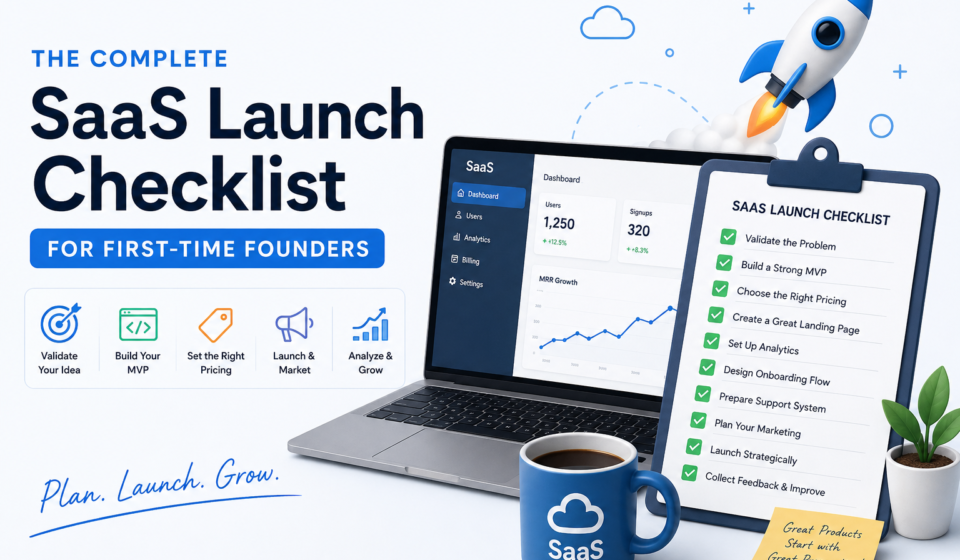
✓ Validated customer demand
✓ Interviewed target users
✓ Built a focused MVP
✓ Tested core functionality
✓ Created a pricing strategy
✓ Built a high-converting landing page
✓ Installed analytics tools
✓ Designed onboarding flows
✓ Prepared customer support systems
✓ Created marketing assets
✓ Built an email list
✓ Planned launch-day activities
✓ Established feedback collection processes
✓ Defined growth metrics
✓ Prepared a post-launch roadmap
Conclusion
Launching a SaaS product for the first time can feel overwhelming, but success rarely comes from perfection. It comes from preparation, customer understanding, and continuous improvement.
The founders who win are not necessarily the ones who build the most advanced products. They are the ones who solve real problems, listen to customers, and iterate quickly.
Use this checklist as your roadmap. Focus on creating value, building relationships with users, and learning from every stage of the journey.
A successful SaaS launch is not about having all the answers on day one. It is about creating a foundation that allows your business to grow, adapt, and thrive over time.