
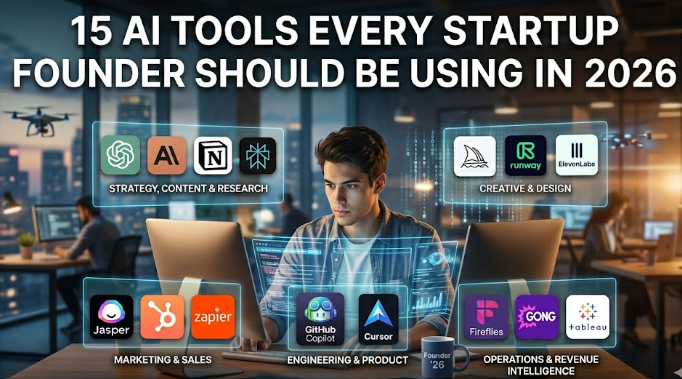

The startup world in 2026 moves faster than ever. New competitors emerge overnight, customer expectations continue to skyrocket, and founders are constantly pressured to do more with significantly fewer resources. In this hyper-accelerated macroeconomic environment, artificial intelligence has completed its evolution: it is no longer just a sleek competitive advantage; it is an absolute business necessity.
Today’s most successful startups are leveraging AI not as an occasional novelty, but as a core operational layer. They use it to automate tedious backend operations, accelerate product development lifecycles, deliver hyper-personalized customer support, generate high-converting marketing content, and synthesize massive datasets into actionable strategic choices.
The good news is that democratization has won. Founders no longer need massive venture backing or sprawling enterprise budgets to tap into world-class capabilities. Modern AI tools are highly accessible, affordable, and capable of clawing back dozens of hours of manual work every single week.
The Top 15 AI Tools for Startups in 2026
To help you navigate a crowded market, we have categorized and broken down the 15 essential AI tools that every startup founder should consider embedding into their workflows this year.
Category 1: Strategy, Content & Research
1. ChatGPT
ChatGPT remains one of the most versatile and ubiquitous AI assistants available for startups. Serving as a generalist partner, it excels at shifting between vastly different contexts at a moment’s notice.
Founders actively use it to:
- Draft foundational business plans and financial models.
- Create multi-channel marketing content and thought leadership pieces.
- Conduct rapid market research and demographic profiling.
- Build initial customer support routing matrices.
Instead of hiring multiple expensive specialists or agency partners during the pre-seed or seed stages, startups use ChatGPT as an always-available, highly competent strategic chief of staff.
- Best For: Content creation, general research, cross-functional ideation, and daily productivity.
2. Claude
Claude has cemented itself as the premier choice among founders who routinely handle large documents, intricate business analysis, and nuanced legal frameworks. Known for its sophisticated reasoning capabilities, exceptional writing tone, and massive context window, Claude reads between the lines where other tools stumble.
Whether you are uploading a 100-page vendor contract, analyzing an extensive industry report, parsing complex regulatory compliance updates, or refining an investor pitch deck, Claude handles information density gracefully. It doesn’t just summarize; it synthesizes structural weaknesses, flags hidden liabilities, and suggests strategic counters.
- Best For: Heavy business analysis, dense document review, legal/financial synthesis, and strategic planning.
3. Notion AI
Managing startup knowledge can quickly devolve into chaos when a team grows from three people to fifteen. Notion AI steps in to solve this structural friction by embedding intelligence directly into your team’s workspace.
Instead of treating your internal wiki as a static graveyard of outdated Google Docs, Notion AI turns it into an active asset. It automatically summarizes messy meeting transcripts, converts bullet points into fully formatted project documentation, and surfaces institutional knowledge instantly. If a new engineering hire needs to find the product spec for an upcoming feature, they no longer have to ping a busy product manager—they can simply ask their workspace.
- Best For: Internal knowledge management, workspace organization, and asynchronous team collaboration.
4. Perplexity AI
Traditional search engines are fundamentally unsuited for the speed of modern startup operations; sifting through pages of SEO-optimized link farm results wastes precious time. Perplexity AI bypasses the link clicking entirely by operating as an answer engine.
It scours the live web in real time, extracts the exact data points you need, and synthesizes a comprehensive response complete with inline citations. For founders conducting rapid competitive analysis, investigating pricing structures, or seeking validated market statistics for an investor meeting, Perplexity provides answers in seconds rather than hours.
- Best For: Real-time market intelligence, accurate research, and competitive tracking.
Category 2: Visual, Video & Audio Creative
5. Midjourney
Visual branding establishes trust, but early-stage startups rarely have the budget for a dedicated creative agency. Midjourney bridges this gap by enabling founders to generate professional-grade imagery, UI/UX aesthetics, and product concepts through pure text.
In 2026, its ability to render photorealistic product mockups, web assets, and social media imagery means startups can easily test consumer interest before spending capital on manufacturing or front-end development. It allows your marketing to look like a well-funded enterprise from day one.
- Best For: Visual branding, marketing creative assets, and rapid product prototyping.
6. Runway
Video content completely dominates digital marketing, user acquisition, and social commerce. However, traditional video production is notorious for its bottlenecked timelines and high costs. Runway changes this dynamic entirely.
By utilizing advanced generative video models, Runway allows small teams to generate cinematic marketing clips, edit existing footage via simple text prompts, and scale video variations for localized ad campaigns. It effectively democratizes video production, putting a full-scale animation and editing studio onto a founder’s laptop.
- Best For: Generative video creation, cinematic asset editing, and ad campaign scaling.
7. ElevenLabs
As audio content—such as podcasts, voice-activated applications, and narrated articles—continues to grow, ElevenLabs provides the infrastructure to scale it. Using advanced emotional nuance and natural cadence, it generates human-like AI voiceovers in dozens of languages.
Startups utilize ElevenLabs to instantly convert product documentation into audio guides, voice-over their marketing materials, or build voice interactions into their actual software products, circumventing the need for expensive voice actors and recording studios.
- Best For: Hyper-realistic AI voice generation and scalable audio content.
Category 3: Marketing, Sales & Growth
8. Jasper
While general AI assistants are helpful, Jasper is purpose-built for enterprise-level marketing and brand management. It allows startups to upload their specific brand voice guidelines, style guides, and product positioning matrices.
Once trained on your startup’s distinct identity, Jasper ensures that every single piece of output—be it a long-form blog post, an outbound email campaign, Google ad copy, or a landing page headline—sounds exactly like your company. This programmatic brand consistency is vital for building long-term consumer trust.
- Best For: High-volume marketing content generation and brand voice enforcement.
9. HubSpot AI
Customer relationship management (CRM) is the lifeblood of a growing B2B or B2C startup. HubSpot AI supercharges traditional customer pipelines by inserting predictive intelligence and automated execution straight into your sales pipeline.
The platform automatically analyzes incoming leads, scores them based on conversion likelihood, crafts personalized email nurture sequences, and surfaces deep analytical insights regarding where friction exists in your sales funnel. It allows a single sales development representative (SDR) to manage the pipeline volume of an entire traditional department.
- Best For: Sales automation, lead scoring, and customer relationship management.
10. Zapier AI
Automation is the ultimate leverage for a lean team. Zapier AI allows founders to connect disparate software applications and build complex, conditional logic workflows using plain natural language rather than brittle API code.
For instance, you can tell Zapier AI: “When a new lead fills out our typeform, look up their company size via LinkedIn, drop a summary into Slack, and if they have more than 50 employees, create a high-priority opportunity in our CRM.” This background orchestration eliminates hours of soul-crushing data entry.
- Best For: Code-free workflow automation and cross-platform app integration.
Category 4: Engineering & Product Development
11. GitHub Copilot
For technology-focused startups, time-to-market is the primary metric that determines survival. GitHub Copilot functions as an AI pair programmer embedded directly inside the code editor, suggesting lines, functions, and entire blocks of code in real time.
By handling boilerplate code, writing unit tests automatically, and debugging syntax errors on the fly, Copilot dramatically accelerates developer velocity. Startups consistently report that their engineering teams are twice as fast, allowing them to ship new features and iterations well ahead of legacy competitors.
- Best For: Software development speed and automated code generation.
12. Cursor
While Copilot acts as an assistant within a traditional setup, Cursor is an AI-first code editor built from the ground up to redefine how software is engineered. It treats the AI as a primary collaborator with full awareness of your entire codebase.
Engineers can instruct Cursor to refactor massive sections of an application, diagnose complex architectural bugs spanning multiple files, or implement entire feature sets asynchronously. For technical founders or small dev teams, Cursor provides the leverage needed to maintain an incredibly fast product deployment rhythm.
- Best For: Deep AI-assisted software engineering and codebase refactoring.
Category 5: Operations & Revenue Intelligence
13. Fireflies AI
Startup meetings are highly valuable, but the core insights often vanish into thin air the moment the video call ends. Fireflies AI sits silently in your Zoom, Teams, or Google Meet sessions to record, transcribe, search, and analyze conversations.
Instead of assigning a team member to take notes, Fireflies automatically generates beautifully formatted summaries, action items, and structural takeaways. This ensures that everyone stays aligned and allows absent stakeholders to review an hour-long meeting in under two minutes.
- Best For: Automated meeting transcription, search, and operational alignment.
14. Gong AI
If your startup depends on closing mid-market or enterprise sales deals, understanding customer interactions is vital. Gong AI records and analyzes customer-facing conversations across phone, video, and email to pinpoint exactly why deals are won or lost.
It flags macro-level market trends, alerts founders when competitors are mentioned, and highlights the specific talk tracks that correlate with successful conversions. It takes the guesswork out of sales coaching and revenue forecasting.
- Best For: Sales optimization, revenue intelligence, and customer interaction analytics.
15. Tableau AI
Data-driven decision-making separates high-growth startups from those that burn through cash blindly. Tableau AI takes the complexity out of business intelligence by enabling founders to query their databases using conversational language.
Instead of writing complex SQL queries or waiting for a data analyst to build a dashboard, you can simply ask: “Show me our month-over-month retention cohort split by acquisition channel.” The platform instantly visualizes the data, highlighting underlying trends, opportunities, and hidden operational risks.
- Best For: Business intelligence, conversational data analytics, and predictive data visualization.
Direct Comparison: The Startup AI Matrix
To help you quickly understand where each tool fits within your immediate operational budget and business focus, use the comprehensive breakdown below:
| AI Tool | Primary Functional Category | Target Value Proposition | Ideal Company Stage |
| ChatGPT | Strategy & Content | Universal cross-functional assistant | Ideation to Scale |
| Claude | Strategy & Analysis | Sophisticated reasoning & document synthesis | Seed to Series A |
| Notion AI | Operations | Knowledge base centralization | Early Team Formation |
| Perplexity AI | Strategy & Research | Real-time answer engine with citations | Continuous |
| Midjourney | Creative & Design | Professional visual asset generation | Pre-Product to Growth |
| Runway | Creative & Design | Generative video creation and scaling | Growth & Marketing |
| ElevenLabs | Creative & Design | Natural, realistic AI audio and voice generation | Product Scale |
| Jasper | Marketing & Sales | Brand-aligned, high-volume copywriting | GTM Launch |
| HubSpot AI | Marketing & Sales | Automated customer management and pipelines | Scaling Sales |
| Zapier AI | Operations | Multi-app workflow automation without code | MVP onwards |
| GitHub Copilot | Engineering | Inline code generation and autocomplete | Technical Development |
| Cursor | Engineering | Full-codebase AI cooperative engineering | Technical Development |
| Fireflies AI | Operations | Meeting transcription and task extraction | Team Expansion |
| Gong AI | Marketing & Sales | Revenue intelligence and sales analytics | Active Sales Outbound |
| Tableau AI | Operations | Conversational data visualization and BI | Data-Rich Environments |
How Startup Founders Should Build Their AI Stack
The most common trap for founders in 2026 is “AI Tool Fatigue.” Swept up by the excitement of automation, it is incredibly easy to adopt fifteen different subscription platforms at once, which introduces operational bloat, context switching, and unnecessary overhead.
Instead of trying to deploy every tool simultaneously, look at your startup through four foundational quadrants:
- Content & Communication
- Product & Engineering
- Customer Acquisition & Retention
- Business Operations
Pick one primary tool for the quadrant that addresses your biggest current bottleneck. For an early-stage software startup, a lean, highly optimized AI tech stack might look like this:
- ChatGPT for content creation, email drafting, and strategic ideation.
- Cursor or GitHub Copilot to double the speed of your product engineering.
- HubSpot AI to capture, track, and nurture your early user signups.
- Zapier AI to quietly connect all these platforms behind the scenes.
This simple, four-tool framework can save a founding team up to 30 hours a week, effectively extending your financial runway and keeping your operations incredibly lean.
Final Thoughts
The startups winning the market in 2026 are not necessarily those with the deepest venture capital pockets or the largest headcounts. The winners are the agile operators using artificial intelligence to compress time, move faster, work leaner, and scale smarter.
AI has graduated from being a simple software feature to your most dependable, tireless, and scalable business partner. The earlier you thoughtfully integrate these platforms into your team’s day-to-day habits, the compounding returns will set you apart from slower-moving legacy players.
The core question facing modern founders is no longer if you should adopt artificial intelligence. The only question that matters is: How fast can you implement it?