
Starting a business is an exciting journey, but one of the first major decisions entrepreneurs face is how to fund their venture. While some founders choose to build their companies using their own savings and business revenue, others seek external investment from venture capital firms to accelerate growth. Both approaches have helped create highly successful businesses, yet each comes with unique advantages, challenges, and trade-offs.
The right funding strategy depends on your business model, growth ambitions, industry, and personal goals as a founder. A software startup targeting a global market may benefit from venture capital, while a consulting firm or niche e-commerce business may thrive through bootstrapping.
This guide explores the differences between bootstrapping and venture capital, their benefits and drawbacks, and how to determine which funding path aligns with your entrepreneurial vision.
What Is Bootstrapping?
Bootstrapping refers to starting and growing a business using personal savings, revenue generated by the business, or support from friends and family rather than raising money from outside investors.
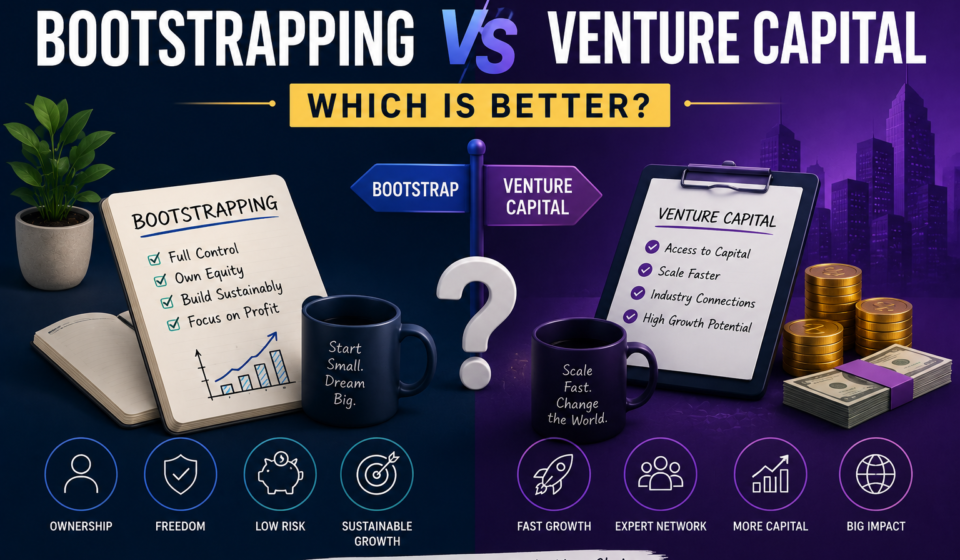
Bootstrapped businesses typically focus on sustainable growth, careful spending, and profitability from an early stage. Since founders retain ownership, they maintain full control over business decisions and direction.
Many successful businesses began as bootstrapped ventures, proving that significant funding isn’t always necessary to build a profitable company.
What Is Venture Capital?
Venture capital (VC) is funding provided by investment firms or individual investors to startups with high growth potential. In exchange for capital, investors receive an ownership stake in the company.
Venture capital is most common in industries such as technology, software, artificial intelligence, biotechnology, and fintech, where businesses often require substantial funding before becoming profitable.
VC-backed companies usually prioritize rapid growth, market expansion, product development, and customer acquisition.
How Bootstrapping Works
Bootstrapped founders often begin with limited resources.
Funding may come from:
- Personal savings
- Revenue from early customers
- Freelance income
- Small business profits
- Personal loans
- Support from family or friends
As revenue grows, profits are reinvested into hiring, marketing, product improvements, and expansion.
This approach encourages financial discipline and efficient resource management.
How Venture Capital Works
The venture capital process generally involves:
- Building a scalable business idea
- Creating a strong business plan
- Developing a prototype or minimum viable product
- Pitching investors
- Raising funding
- Giving investors equity in exchange for capital
- Scaling rapidly with investor support
Investors expect significant returns, which means businesses often face pressure to grow quickly.
Advantages of Bootstrapping
Full Ownership
Founders maintain complete control over the company without giving away equity.
Greater Independence
Business decisions remain with the founder rather than investors or board members.
Financial Discipline
Limited resources encourage careful budgeting and efficient spending.
Long-Term Focus
Bootstrapped companies can prioritize sustainable growth instead of aggressive expansion.
Higher Future Rewards
If the company becomes successful, founders retain a larger share of profits and business value.
Challenges of Bootstrapping
Limited Capital
Growth may be slower due to restricted financial resources.
Slower Hiring
Hiring experienced employees may take longer.
Limited Marketing Budget
Advertising and customer acquisition efforts may need to rely on cost-effective channels like SEO and content marketing.
Higher Personal Financial Risk
Founders often invest their own savings, increasing personal financial exposure.
Advantages of Venture Capital
Faster Growth
Investment allows businesses to expand more quickly.
Access to Expertise
Many venture capital firms provide mentorship, strategic guidance, and valuable industry connections.
Easier Hiring
Companies can attract experienced employees by offering competitive salaries and benefits.
Larger Marketing Budget
Funding enables significant investment in customer acquisition and brand awareness.
Competitive Advantage
Well-funded businesses may develop products faster and enter new markets more aggressively.
Challenges of Venture Capital
Loss of Ownership
Founders give up a portion of their company in exchange for investment.
Investor Expectations
Investors expect strong growth and measurable returns.
Reduced Control
Major business decisions may require investor approval.
Pressure to Scale Quickly
Rapid growth can increase operational complexity and financial risk.
More Reporting Requirements
Founders often spend significant time preparing updates for investors and board meetings.
Bootstrapping vs Venture Capital: Key Differences
| Factor | Bootstrapping | Venture Capital |
|---|---|---|
| Ownership | Founder retains ownership | Shared with investors |
| Growth Speed | Gradual | Rapid |
| Financial Risk | Founder assumes most risk | Risk shared with investors |
| Decision-Making | Founder controls decisions | Investors often influence strategy |
| Profitability | Often prioritized early | May be delayed in favor of growth |
| Funding Availability | Limited | Significant capital available |
| Flexibility | High | Moderate |
| Reporting | Minimal | Regular investor reporting |
Which Businesses Should Bootstrap?
Bootstrapping is often a good fit for businesses such as:
- Freelance services
- Marketing agencies
- Consulting firms
- Online education platforms
- Content creation businesses
- E-commerce stores
- Design studios
- Local service businesses
These businesses can often generate revenue quickly without requiring substantial upfront investment.
Which Businesses Benefit From Venture Capital?
Venture capital is commonly suited to businesses that require large investments before becoming profitable, including:
- SaaS companies
- Artificial intelligence startups
- Biotechnology firms
- Fintech platforms
- Health technology companies
- Enterprise software providers
- Deep technology startups
- Marketplace platforms
These businesses often need funding for research, development, infrastructure, and rapid customer acquisition.
Questions to Ask Before Choosing a Funding Strategy
Before deciding, consider the following:
- How quickly do you want to grow?
- Are you comfortable sharing ownership?
- Can your business become profitable without external funding?
- How much capital do you actually need?
- Do you value independence or rapid expansion more?
- Is your business suitable for venture investment?
Answering these questions helps clarify the best path for your situation.
Can You Combine Both Approaches?
Yes. Many successful businesses begin by bootstrapping their early operations. Once they validate their product, gain customers, and demonstrate market demand, they raise venture capital to accelerate expansion.
This hybrid approach allows founders to retain more ownership during the early stages while still accessing funding when growth opportunities increase.
Common Mistakes Entrepreneurs Make
Regardless of the funding model, avoid these common mistakes:
- Raising money before validating the business idea
- Overspending after securing investment
- Ignoring profitability
- Giving away too much equity too early
- Underestimating operating expenses
- Scaling before achieving product-market fit
- Failing to build strong financial systems
Careful planning and disciplined execution are essential for long-term success.
Final Thoughts
There is no universal answer to whether bootstrapping or venture capital is better. The right choice depends on your business goals, industry, financial needs, and leadership style.
Bootstrapping offers independence, ownership, and sustainable growth, making it ideal for businesses that can generate revenue early and scale gradually. Venture capital provides access to significant resources, experienced mentors, and faster expansion, making it well suited for startups targeting large markets or developing capital-intensive products.
Some entrepreneurs thrive by remaining fully independent, while others build globally recognized companies with investor support. The most important decision is choosing the funding strategy that aligns with your vision, values, and long-term objectives rather than following trends.
Frequently Asked Questions (FAQs)
1. What is bootstrapping in business?
Bootstrapping is the process of starting and growing a business using personal savings, business revenue, or other self-funded resources instead of raising money from outside investors.
2. What is venture capital?
Venture capital is funding provided by investors to startups with high growth potential in exchange for equity or ownership in the company.
3. Is bootstrapping better than venture capital?
Neither option is universally better. Bootstrapping offers greater control and ownership, while venture capital provides funding and resources for faster growth. The best choice depends on your business model and goals.
4. Which businesses are best suited for bootstrapping?
Service-based businesses, consulting firms, agencies, online education platforms, content businesses, and many e-commerce companies often succeed with bootstrapping because they can generate revenue relatively quickly.
5. Why do startups seek venture capital?
Startups pursue venture capital to fund product development, hire experienced teams, expand into new markets, accelerate customer acquisition, and scale faster than they could through revenue alone.
6. Do founders lose control after raising venture capital?
Founders usually retain operational leadership, but investors often receive board seats and influence important strategic decisions based on their ownership stake and investment agreements.
7. Can a company switch from bootstrapping to venture capital later?
Yes. Many businesses bootstrap during their early stages and raise venture capital after validating their product, building revenue, and demonstrating market demand.
8. What is the biggest risk of bootstrapping?
The primary risk is limited capital, which may slow growth and increase the founder’s personal financial exposure if the business takes longer than expected to become profitable.
9. What is the biggest advantage of venture capital?
The biggest advantage is access to substantial funding that enables faster growth, hiring, product development, and market expansion, often supported by experienced investors and industry networks.
10. How should entrepreneurs choose between bootstrapping and venture capital?
Entrepreneurs should evaluate their funding needs, growth goals, industry requirements, willingness to share ownership, and long-term vision before deciding which approach best supports their business strategy.