
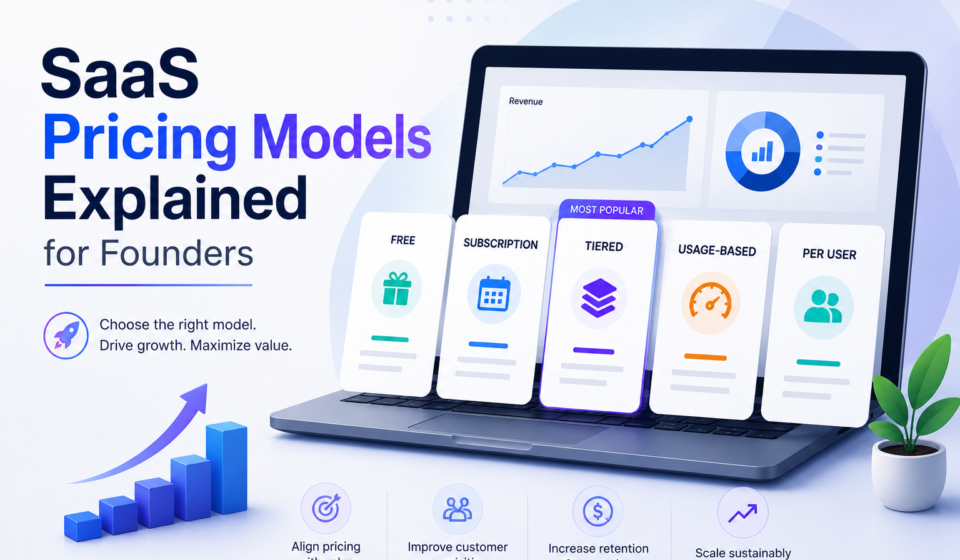

Pricing is one of the most critical decisions SaaS founders make when building and scaling a software business. While product development, marketing, and customer acquisition often receive significant attention, pricing strategy directly impacts revenue growth, customer retention, profitability, and long-term business success. A well-designed pricing model can accelerate growth, improve customer satisfaction, and create sustainable competitive advantages. Conversely, poor pricing decisions can limit revenue potential and hinder scalability.
The Software-as-a-Service (SaaS) industry has evolved rapidly over the past two decades, giving rise to various pricing models designed to accommodate different customer needs, business objectives, and market conditions. From simple subscription plans to sophisticated usage-based pricing structures, SaaS companies have numerous options available when determining how to monetize their products.
For startup founders, selecting the right pricing model involves balancing customer expectations, market dynamics, operational costs, and growth objectives. Understanding the strengths and limitations of different pricing approaches helps entrepreneurs create strategies that maximize both customer value and business performance.
This article explores the most common SaaS pricing models, their advantages and disadvantages, factors influencing pricing decisions, and best practices founders can use to optimize their pricing strategies.
Why Pricing Matters in SaaS Businesses
Pricing affects nearly every aspect of a SaaS business. It influences customer acquisition, revenue generation, customer retention, profitability, and market positioning. Unlike traditional product businesses, SaaS companies operate on recurring revenue models, making pricing decisions particularly important for long-term sustainability.
Even small pricing adjustments can produce significant changes in business performance. Increasing average revenue per user, improving customer lifetime value, or reducing churn can substantially impact profitability over time.
Pricing also communicates value. Customers often use pricing as an indicator of product quality, market positioning, and business credibility. A pricing strategy that aligns with customer expectations strengthens trust and supports sustainable growth.
Founders who treat pricing as a strategic business function rather than a simple financial calculation often achieve stronger long-term outcomes.
Understanding SaaS Pricing Fundamentals
Before selecting a pricing model, founders must understand several core SaaS metrics that influence pricing decisions.
Monthly Recurring Revenue (MRR) represents the predictable monthly income generated through subscriptions. Annual Recurring Revenue (ARR) measures yearly subscription revenue.
Customer Acquisition Cost (CAC) refers to the expense required to acquire new customers. Customer Lifetime Value (LTV) estimates the total revenue generated by customers throughout their relationship with the company.
Churn rate measures customer attrition and significantly affects long-term profitability. Effective pricing strategies help optimize these metrics and improve overall business performance.
Understanding these financial fundamentals allows founders to evaluate pricing models more effectively and make data-driven decisions.
Common SaaS Pricing Models
| Pricing Model | Description | Best For | Revenue Predictability |
|---|---|---|---|
| Flat-rate pricing | Single fixed subscription fee | Simple products | High |
| Tiered pricing | Multiple subscription levels | Growing businesses | High |
| Per-user pricing | Pricing based on number of users | Team software | Medium |
| Usage-based pricing | Charges based on consumption | Infrastructure platforms | Variable |
| Freemium pricing | Free basic version with paid upgrades | High-volume markets | Medium |
| Feature-based pricing | Pricing based on available features | Specialized software | High |
| Hybrid pricing | Combination of multiple models | Complex SaaS products | High |
Selecting the right pricing model depends on customer behavior, product complexity, market competition, and business goals.
Flat-Rate Pricing
Flat-rate pricing represents one of the simplest SaaS pricing structures. Customers pay a single subscription fee for access to the entire product offering.
This model offers several advantages. It simplifies purchasing decisions, reduces pricing confusion, and creates predictable recurring revenue. Customers appreciate transparency and straightforward pricing structures.
Flat-rate pricing also simplifies sales processes and financial forecasting. For early-stage startups with relatively simple products, this model can provide operational efficiency and ease of implementation.
However, flat-rate pricing has limitations. Businesses may struggle to capture additional revenue from high-value customers while potentially overcharging smaller customers with limited needs.
As products become more sophisticated, many SaaS companies transition toward more flexible pricing structures.
Tiered Pricing Models
Tiered pricing has become one of the most widely used SaaS pricing strategies. Under this approach, companies offer multiple subscription plans with varying features, capabilities, and price points.
This model allows businesses to serve different customer segments effectively. Small businesses, mid-sized organizations, and enterprise clients can each select plans aligned with their requirements and budgets.
Tiered pricing increases revenue opportunities by encouraging customers to upgrade as their needs evolve. It also supports customer growth and improves retention by providing clear expansion pathways.
Successful tiered pricing strategies carefully differentiate plan features while maintaining simplicity and transparency. Excessively complex pricing structures can confuse customers and reduce conversion rates.
Many leading SaaS companies rely heavily on tiered pricing because of its flexibility and scalability.
Per-User Pricing
Per-user pricing charges customers based on the number of individuals using the software platform. This approach has become particularly common among collaboration tools, customer relationship management systems, and enterprise productivity applications.
The primary advantage of per-user pricing is its simplicity. Customers understand the pricing structure easily, and businesses benefit from revenue growth as customer organizations expand.
Per-user pricing also aligns revenue with customer usage and organizational growth. As companies hire additional employees or expand teams, subscription revenue naturally increases.
However, this model can discourage broader product adoption within organizations. Customers may limit access to reduce costs, potentially restricting engagement and long-term value creation.
Founders considering per-user pricing should carefully evaluate how pricing influences user behavior and customer satisfaction.
Usage-Based Pricing
Usage-based pricing, often referred to as consumption-based pricing, charges customers according to their actual usage of a product or service. Examples include pricing based on API requests, storage consumption, transaction volume, or computing resources.
This model aligns costs closely with customer value creation. Customers pay only for what they use, which often improves satisfaction and reduces barriers to adoption.
Usage-based pricing can accelerate customer acquisition because organizations face lower initial commitments. Businesses also benefit from strong expansion opportunities as customer usage increases.
However, revenue forecasting becomes more complex because customer spending fluctuates over time. Some customers may also prefer predictable costs rather than variable expenses.
Cloud infrastructure providers and developer-focused platforms frequently adopt usage-based pricing strategies.
Freemium Pricing Strategies
Freemium pricing offers customers free access to basic functionality while charging for premium features, advanced capabilities, or increased usage limits.
This model has become particularly popular among SaaS startups seeking rapid market penetration and user acquisition. Free offerings reduce adoption barriers and allow customers to experience product value before committing financially.
Freemium models can generate substantial user growth and strong brand awareness. Successful implementations create clear upgrade pathways that encourage conversion to paid subscriptions.
However, freemium pricing presents challenges. Supporting large numbers of non-paying users can increase operational costs, and conversion rates from free to paid plans are often relatively low.
Businesses implementing freemium strategies must carefully balance customer acquisition objectives with long-term profitability requirements.
Feature-Based Pricing
Feature-based pricing structures subscription plans according to the capabilities and functionality available to customers.
This approach enables businesses to segment customers based on complexity requirements and willingness to pay. Entry-level customers receive essential functionality, while advanced users gain access to premium capabilities.
Feature-based pricing creates strong opportunities for upselling and customer expansion. Organizations often upgrade subscriptions as their needs become more sophisticated.
However, determining which features belong in each pricing tier requires careful strategic analysis. Incorrect feature allocation can limit revenue opportunities or reduce customer satisfaction.
Successful feature-based pricing emphasizes value differentiation rather than arbitrary restrictions.
Hybrid Pricing Models
Many modern SaaS companies combine multiple pricing approaches to create hybrid models that better address diverse customer needs.
For example, a company may combine subscription pricing with usage-based charges or offer tiered plans that include per-user pricing components. Hybrid models provide greater flexibility and allow businesses to optimize revenue across multiple customer segments.
Hybrid pricing structures can improve monetization efficiency while accommodating varying usage patterns and organizational requirements.
However, increased flexibility often introduces additional complexity. Founders must ensure that hybrid pricing remains understandable and transparent to customers.
As SaaS markets mature, hybrid pricing strategies continue becoming increasingly common.
Value-Based Pricing
Value-based pricing focuses on the economic value customers receive rather than the costs associated with providing the product.
Under this approach, companies evaluate how their software impacts customer revenue, productivity, efficiency, or profitability. Pricing decisions reflect the measurable value delivered rather than operational expenses.
Value-based pricing often generates higher profit margins and stronger customer relationships. Customers are generally willing to pay premium prices when they clearly understand the business value provided.
However, implementing value-based pricing requires deep customer understanding, strong positioning, and effective communication.
Founders who successfully adopt value-based pricing often create substantial competitive advantages.
Factors Founders Should Consider When Choosing a Pricing Model
Selecting an appropriate pricing strategy requires evaluating numerous business and market factors.
Customer behavior plays a central role. Founders should understand how customers perceive value, make purchasing decisions, and use products over time.
Competitive positioning also influences pricing strategy. Businesses must evaluate industry standards while identifying opportunities for differentiation.
Product complexity affects pricing structure selection. Simple products often benefit from straightforward pricing models, while sophisticated platforms may require more flexible approaches.
Operational costs, growth objectives, market maturity, and customer acquisition strategies should also influence pricing decisions.
Successful pricing strategies align business objectives with customer expectations.
Common SaaS Pricing Mistakes
Many founders underestimate the strategic importance of pricing and make avoidable mistakes during product development and market expansion.
One common error involves setting prices too low. Entrepreneurs often fear losing customers and underestimate the value of their products. Underpricing can limit revenue growth and create perceptions of lower quality.
Another frequent mistake is excessive pricing complexity. Customers prefer transparent pricing structures that are easy to understand and evaluate.
Ignoring customer feedback also creates problems. Pricing strategies should evolve based on customer behavior, market conditions, and competitive dynamics.
Additionally, some founders avoid revisiting pricing decisions after launch. Successful SaaS businesses continuously test and optimize pricing models over time.
How to Test and Optimize SaaS Pricing
Pricing optimization should be viewed as an ongoing process rather than a one-time decision. Successful SaaS companies regularly evaluate pricing performance and make data-driven adjustments.
Customer interviews provide valuable insights into willingness to pay, perceived value, and purchasing behavior. Usage analytics help identify opportunities for segmentation and expansion.
A/B testing allows businesses to compare pricing strategies and evaluate conversion performance. Revenue metrics, retention rates, and customer satisfaction indicators also provide important information.
Continuous experimentation enables founders to improve monetization while maintaining strong customer relationships.
Organizations that actively optimize pricing often outperform competitors that rely on static pricing strategies.
The Future of SaaS Pricing Models
The SaaS industry continues evolving rapidly, and pricing strategies are becoming increasingly sophisticated. Artificial intelligence, automation, and advanced analytics are enabling businesses to create more personalized pricing experiences.
Usage-based pricing is gaining popularity as customers seek greater flexibility and alignment between costs and value received. Hybrid pricing models are also becoming more common across enterprise software markets.
Dynamic pricing, personalized pricing, and AI-assisted pricing optimization may play increasingly important roles in the future.
As competition intensifies, pricing strategy will remain a critical source of competitive advantage for SaaS businesses.
Founders who remain adaptable and customer-focused will be best positioned to succeed in evolving markets.
Conclusion
Pricing represents one of the most important strategic decisions SaaS founders make. The right pricing model influences customer acquisition, retention, profitability, and long-term business success.
From flat-rate and tiered pricing to usage-based and hybrid approaches, each model offers unique advantages and challenges. Founders must carefully evaluate customer behavior, market conditions, product complexity, and business objectives when developing pricing strategies.
Successful SaaS companies treat pricing as an ongoing process of experimentation, learning, and optimization. By understanding customer value and continuously refining pricing approaches, entrepreneurs can create sustainable growth and competitive advantages.
Ultimately, effective SaaS pricing is not simply about charging customers. It is about aligning value creation with business objectives in ways that support long-term success for both customers and companies.
Frequently Asked Questions
What is the most common SaaS pricing model?
Tiered pricing is currently one of the most widely used SaaS pricing models because it accommodates multiple customer segments and supports business growth.
Is usage-based pricing better than subscription pricing?
Neither approach is universally superior. The best model depends on customer behavior, product usage patterns, and business objectives.
How often should SaaS companies review pricing?
Most SaaS companies benefit from reviewing pricing strategies at least annually, although rapidly growing businesses may evaluate pricing more frequently.
What is freemium pricing?
Freemium pricing provides free access to basic product functionality while charging for premium features, advanced capabilities, or expanded usage.
Why do SaaS startups often underprice their products?
Many founders underestimate product value, fear losing customers, or lack sufficient market data when establishing initial pricing strategies.
Can SaaS companies change pricing after launch?
Yes. Many successful SaaS businesses adjust pricing over time based on customer feedback, market conditions, competitive factors, and business growth objectives.