
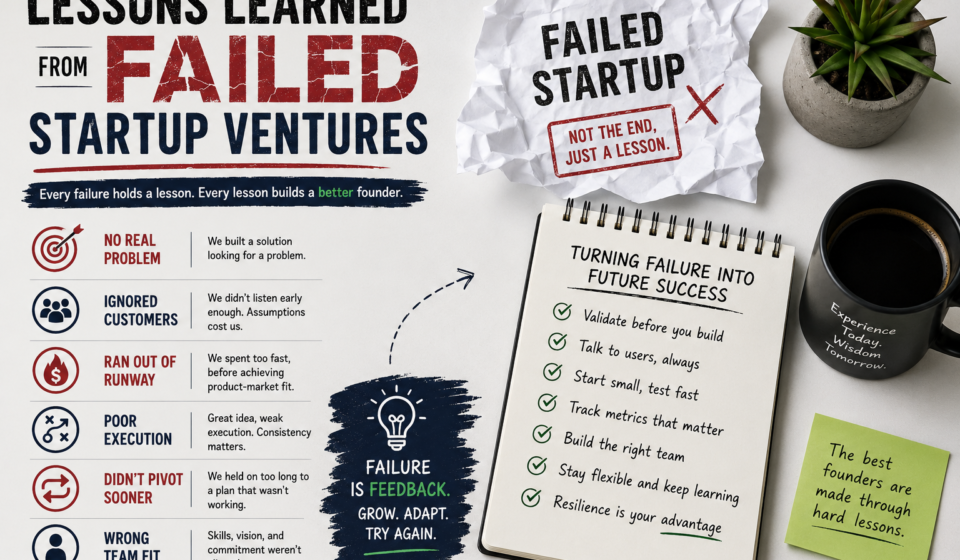

The startup world is often associated with innovation, disruption, and extraordinary success stories. Headlines frequently celebrate unicorn companies, billion-dollar valuations, and visionary founders who transformed industries. However, behind every successful startup lies a much larger number of ventures that failed to achieve their goals. While startup failures can be painful and financially costly, they also provide some of the most valuable lessons entrepreneurs can learn.
Failure is not an exception in entrepreneurship; it is a common part of the journey. Studies consistently show that a significant percentage of startups do not survive beyond their first few years. Despite these statistics, failed ventures often serve as powerful educational experiences that shape stronger entrepreneurs, better business models, and more resilient companies.
Understanding why startups fail and the lessons founders learn from those experiences can help aspiring entrepreneurs avoid common mistakes and build more sustainable businesses. The insights gained from failed startup ventures often become the foundation for future success, providing practical knowledge that cannot be acquired through theory alone.
This article explores the most important lessons learned from failed startups, examining the strategic, operational, financial, and leadership challenges that frequently contribute to business failure.
Understanding the Reality of Startup Failure
Startup failure is more common than many entrepreneurs initially realize. While the reasons for failure vary across industries and markets, certain patterns consistently emerge. These patterns reveal valuable insights into the challenges entrepreneurs face when building new businesses.
Failure does not necessarily indicate poor leadership or lack of effort. Many startups fail despite having talented teams, innovative products, and substantial financial resources. External factors such as market conditions, competition, timing, and economic uncertainty also influence business outcomes.
Recognizing that failure is a normal aspect of entrepreneurship encourages founders to approach business building with greater humility, adaptability, and strategic awareness. Entrepreneurs who learn from failure often develop stronger decision-making abilities and increased resilience.
The Importance of Solving a Real Problem
One of the most common lessons from failed startups is the importance of solving a genuine market problem. Many entrepreneurs become emotionally attached to ideas without sufficiently validating whether customers actually need their products or services.
Successful businesses exist because they address meaningful challenges for specific audiences. When startups prioritize innovation over customer needs, they often struggle to achieve product-market fit and generate sustainable demand.
Founders who experienced failure frequently report that they spent too much time building solutions before thoroughly understanding customer problems. Effective market research, customer interviews, and continuous feedback are essential for developing products that people genuinely value.
Entrepreneurs who validate market demand early reduce the risk of investing significant resources into products with limited commercial potential.
Common Reasons Why Startups Fail
| Reason for Failure | Description | Impact on Business |
|---|---|---|
| Lack of market demand | Customers do not need the product | Revenue growth stagnates |
| Cash flow problems | Insufficient financial resources | Business operations become unsustainable |
| Poor leadership | Ineffective management decisions | Team performance declines |
| Weak product-market fit | Product fails to satisfy customer needs | Customer retention suffers |
| Inadequate marketing | Failure to reach target audience | Customer acquisition slows |
| Scaling too quickly | Expansion exceeds capabilities | Operational challenges increase |
| Competitive pressure | Market competition intensifies | Profitability decreases |
| Team conflicts | Internal disagreements disrupt progress | Organizational stability weakens |
Cash Flow Is More Important Than Revenue
Many failed entrepreneurs emphasize that revenue alone does not guarantee business success. Cash flow management often determines whether a startup survives periods of uncertainty and growth.
Some startups generate impressive sales figures while simultaneously struggling with cash shortages. Poor financial planning, excessive spending, and unrealistic growth assumptions frequently contribute to business failure.
Entrepreneurs who have experienced failure often learn the importance of monitoring cash flow closely, maintaining financial reserves, and controlling operational expenses. Effective financial management enables businesses to withstand unexpected challenges and invest strategically in growth opportunities.
Maintaining sufficient liquidity is particularly important for startups operating in competitive or rapidly changing markets.
Product-Market Fit Cannot Be Ignored
One of the most significant lessons from failed startup ventures is the importance of achieving product-market fit before scaling operations. Product-market fit occurs when a product successfully addresses customer needs and generates consistent demand.
Many entrepreneurs attempt to accelerate growth before validating whether customers truly value their products. This approach often leads to increased expenses, operational complexity, and financial losses.
Failed founders frequently acknowledge that they focused too heavily on fundraising, marketing, or expansion while neglecting customer feedback and product improvement. Successful startups prioritize customer satisfaction and continuously refine their offerings based on market insights.
Achieving strong product-market fit creates a foundation for sustainable growth and long-term business success.
Customer Feedback Is Essential
Entrepreneurs sometimes assume they understand their customers better than they actually do. One recurring lesson from failed ventures is the importance of actively listening to customers throughout the business journey.
Customer feedback provides valuable information about product quality, user experience, pricing, market positioning, and unmet needs. Ignoring customer insights can result in products that fail to resonate with target audiences.
Successful entrepreneurs establish systems for gathering, analyzing, and acting upon customer feedback. This process enables businesses to adapt quickly and maintain alignment with market demands.
Founders who embrace customer feedback often develop stronger products and build more loyal customer relationships.
Timing Matters More Than Expected
Business timing plays a critical role in startup success. Many failed entrepreneurs recognize that their ideas were either introduced too early or too late to achieve widespread adoption.
A product that enters the market before customers are ready may struggle despite offering significant value. Conversely, entering a mature market after competitors have established dominant positions can create substantial challenges.
Understanding market trends, consumer behavior, technological readiness, and economic conditions helps entrepreneurs make more informed decisions about when to launch and scale their businesses.
While entrepreneurs cannot control market timing completely, careful analysis and strategic planning can improve their chances of success.
Building the Right Team Is Critical
Startup success depends heavily on the quality of the team behind the business. Many failed ventures reveal the consequences of poor hiring decisions, unclear responsibilities, and ineffective leadership structures.
Entrepreneurs often underestimate the importance of organizational culture, communication, and talent management during the early stages of growth. Team conflicts, skill gaps, and leadership challenges can significantly impact business performance.
Successful founders prioritize hiring individuals who share the company’s vision, possess complementary skills, and demonstrate adaptability. Strong teams contribute to innovation, resilience, and operational excellence.
Building the right team requires deliberate effort, effective leadership, and ongoing investment in employee development.
Rapid Growth Can Become Dangerous
While growth is often celebrated in the startup ecosystem, scaling too quickly represents a common cause of business failure. Entrepreneurs sometimes expand operations before establishing stable processes, financial sustainability, or product-market fit.
Rapid growth can create operational complexity, increase expenses, strain organizational resources, and reduce customer satisfaction. Businesses that scale prematurely often struggle to maintain quality and efficiency.
Failed entrepreneurs frequently emphasize the importance of sustainable growth strategies. Building strong operational foundations before pursuing aggressive expansion improves long-term outcomes.
Growth should be viewed as a consequence of business success rather than an objective pursued at any cost.
Leadership Skills Determine Outcomes
Technical expertise and innovative ideas alone are insufficient for entrepreneurial success. Leadership capabilities significantly influence business performance and organizational culture.
Many failed founders acknowledge that they lacked essential leadership skills related to communication, delegation, conflict resolution, and strategic decision-making. These deficiencies often become more apparent as businesses grow.
Successful entrepreneurs continuously develop their leadership abilities through education, mentorship, self-reflection, and experience. Strong leadership enables organizations to navigate uncertainty, maintain alignment, and adapt to changing conditions.
Leadership development remains one of the most valuable investments entrepreneurs can make.
Adaptability Is Essential for Survival
Markets evolve rapidly, customer preferences change, and competitive landscapes shift unexpectedly. Entrepreneurs who fail to adapt often struggle to remain relevant.
One of the most important lessons from failed startups is the necessity of maintaining flexibility and openness to change. Businesses that rigidly adhere to outdated strategies risk losing competitive advantages.
Successful entrepreneurs monitor market conditions closely and adjust their approaches when necessary. Adaptability allows organizations to capitalize on new opportunities and mitigate emerging threats.
The ability to pivot effectively often distinguishes successful startups from failed ventures.
Marketing Cannot Be an Afterthought
Many failed startups built excellent products but underestimated the importance of marketing and customer acquisition. A superior product alone rarely guarantees commercial success.
Entrepreneurs frequently learn that effective marketing requires strategic planning, consistent execution, and continuous optimization. Understanding target audiences, communication channels, and customer behavior is essential for growth.
Successful startups invest in brand development, customer engagement, and market positioning from the beginning. Strong marketing strategies create awareness, generate demand, and support long-term business expansion.
Marketing should be integrated into every stage of the entrepreneurial journey rather than treated as a secondary consideration.
Fundraising Is Not the Same as Success
Raising capital is often viewed as a significant milestone for startups. However, many failed entrepreneurs learn that securing investment does not guarantee business viability.
Excessive focus on fundraising can distract founders from developing products, acquiring customers, and achieving profitability. Large investments may also encourage unsustainable spending and unrealistic growth expectations.
Successful entrepreneurs recognize that funding serves as a tool rather than an objective. Capital should support strategic priorities and contribute to sustainable business development.
Businesses that prioritize customer value and operational excellence often achieve stronger long-term outcomes than those focused primarily on fundraising.
Resilience Is a Competitive Advantage
Failure teaches entrepreneurs the importance of resilience, perseverance, and emotional strength. Building a startup involves uncertainty, setbacks, and difficult decisions that test personal and professional capabilities.
Many successful founders experienced multiple failures before achieving meaningful success. These experiences strengthened their decision-making abilities, increased their self-awareness, and improved their leadership skills.
Resilient entrepreneurs view setbacks as opportunities for learning rather than permanent defeats. This mindset supports continuous improvement and long-term growth.
Developing resilience enables founders to maintain motivation and effectiveness despite challenging circumstances.
Data Should Guide Decisions
Entrepreneurs sometimes rely excessively on intuition and personal assumptions when making business decisions. Failed startup experiences often reinforce the importance of using data to support strategic planning.
Data-driven decision-making improves accuracy, reduces uncertainty, and enables businesses to identify emerging trends more effectively. Customer analytics, financial metrics, operational performance indicators, and market research provide valuable insights.
Successful entrepreneurs combine intuition with evidence-based analysis to make informed decisions. This balanced approach reduces risk and supports sustainable business growth.
Organizations that prioritize data often respond more effectively to changing market conditions.
Failure Creates Valuable Experience
Although startup failure can be financially and emotionally difficult, it often produces knowledge that contributes to future success. Entrepreneurs who reflect honestly on their experiences gain practical insights that cannot be acquired through education alone.
Failure teaches humility, discipline, strategic thinking, resilience, and adaptability. These qualities strengthen entrepreneurial capabilities and improve future decision-making.
Many highly successful founders attribute their achievements to lessons learned through previous failures. Their experiences provided valuable perspectives that shaped stronger businesses and more effective leadership approaches.
Rather than viewing failure as an endpoint, entrepreneurs increasingly recognize it as an important stage in the process of growth and innovation.
Conclusion
Failed startup ventures provide some of the most valuable lessons available to entrepreneurs. From understanding customer needs and managing finances to building strong teams and maintaining adaptability, the insights gained through failure often become essential foundations for future success.
Entrepreneurship involves uncertainty, risk, and continuous learning. While no founder seeks failure, the experiences associated with unsuccessful ventures frequently contribute to stronger leadership, better decision-making, and improved business strategies.
The most successful entrepreneurs are not necessarily those who avoid failure entirely, but those who learn from setbacks, adapt their approaches, and continue pursuing opportunities with greater wisdom and resilience.
By studying the lessons learned from failed startups, aspiring entrepreneurs can avoid common mistakes, strengthen their businesses, and increase their chances of achieving long-term success.
Frequently Asked Questions
Why do most startups fail?
Startups commonly fail because of insufficient market demand, poor cash flow management, weak product-market fit, ineffective leadership, inadequate marketing, and operational challenges.
Is startup failure common?
Yes. Startup failure is relatively common across industries, particularly during the early stages of business development. Failure is often considered a normal part of entrepreneurship.
What is the biggest lesson entrepreneurs learn from failure?
One of the most important lessons is the importance of understanding customer needs and validating market demand before investing heavily in product development or expansion.
Can entrepreneurs succeed after a failed startup?
Absolutely. Many successful entrepreneurs experienced multiple failures before achieving significant business success. Failure often provides valuable experience and insights.
How can startups avoid common mistakes?
Entrepreneurs can reduce risk by conducting market research, managing finances carefully, listening to customers, building strong teams, and maintaining flexibility.
Does raising investment guarantee startup success?
No. While funding can support growth, long-term success depends on creating customer value, achieving product-market fit, and maintaining operational excellence.


