
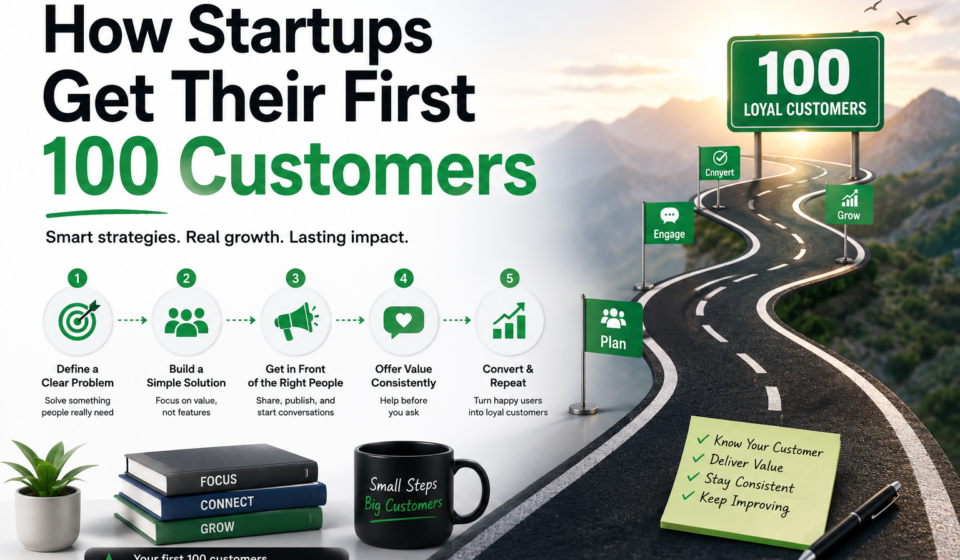

Getting the first 100 customers is one of the most challenging and important milestones in a startup’s journey. While building a product requires creativity and technical expertise, acquiring customers demands persistence, experimentation, and a deep understanding of market needs. For many startups, the first 100 customers represent far more than initial revenue. They provide validation, feedback, credibility, and the foundation for future growth.
Many successful companies that are now global brands once faced the same challenge of finding their first customers. During the early stages, startups often have limited budgets, small teams, and little brand recognition. Unlike established businesses that can rely on reputation and large marketing budgets, startups must identify creative, efficient, and scalable ways to attract their earliest users.
The process of acquiring the first 100 customers is rarely straightforward. It involves testing assumptions, refining messaging, building relationships, and continuously improving products based on customer feedback. Founders who successfully navigate this stage often develop a deeper understanding of their markets and create stronger foundations for long-term success.
This article explores the most effective strategies startups use to acquire their first 100 customers, the challenges entrepreneurs face during early customer acquisition, and the lessons founders can apply to accelerate business growth.
Why the First 100 Customers Matter
The first 100 customers represent a critical validation stage for every startup. Before reaching this milestone, entrepreneurs often operate based on assumptions regarding customer behavior, market demand, pricing, and product value.
Early customers provide direct evidence that a business solves a meaningful problem. Their feedback helps founders improve products, refine messaging, and identify opportunities for growth.
The first 100 customers also contribute to social proof and credibility. Positive reviews, testimonials, referrals, and case studies generated by early adopters strengthen market trust and support future customer acquisition efforts.
Most importantly, this milestone helps founders transition from building products to building sustainable businesses.
Understanding Customer Problems Before Selling
One of the biggest mistakes startups make is focusing excessively on their products rather than the problems they solve. Successful founders spend considerable time understanding customer challenges before attempting to sell solutions.
Customer interviews provide valuable insights into pain points, goals, frustrations, and purchasing behaviors. These conversations often reveal opportunities and challenges that entrepreneurs had not previously considered.
Understanding customer problems allows startups to develop stronger value propositions and create messaging that resonates with target audiences.
The best customer acquisition strategies begin with empathy and a deep understanding of customer needs.
Common Channels for Acquiring the First 100 Customers
| Customer Acquisition Channel | Cost Level | Speed | Effectiveness for Early Startups |
|---|---|---|---|
| Personal network | Low | Fast | Very high |
| Referrals | Low | Medium | High |
| Social media | Low | Medium | High |
| Content marketing | Low | Slow | High |
| Cold outreach | Low | Medium | Moderate |
| Online communities | Low | Fast | High |
| Paid advertising | Medium | Fast | Moderate |
| Partnerships | Medium | Medium | High |
Most successful startups rely on multiple acquisition channels rather than a single strategy.
Starting With Personal Networks
Many successful startups acquire their earliest customers through personal and professional relationships. Friends, colleagues, mentors, former coworkers, and industry contacts often become valuable sources of early users and referrals.
Personal networks provide several advantages. Trust already exists, communication is easier, and feedback tends to be more honest and detailed. Early customers from personal connections can help founders refine products and validate assumptions.
Entrepreneurs sometimes hesitate to leverage their networks because they fear appearing overly promotional. However, sharing solutions with relevant contacts who may genuinely benefit from a product often creates valuable opportunities.
Many major companies acquired their earliest users through direct personal outreach and relationship-building efforts.
Conducting Customer Interviews
Customer interviews remain one of the most effective tools for early-stage startups. Rather than focusing immediately on sales, successful founders prioritize learning.
Interviews help entrepreneurs understand customer behavior, identify pain points, evaluate purchasing decisions, and test product assumptions. These insights support both product development and marketing strategies.
Customer conversations also create opportunities to establish relationships and identify potential early adopters. Individuals who contribute feedback often become some of a startup’s strongest advocates.
Founders who conduct extensive customer interviews frequently achieve product-market fit more quickly than those who rely primarily on assumptions.
Building in Public
Building in public has become an increasingly popular strategy among startup founders. This approach involves sharing the entrepreneurial journey openly through social media platforms, blogs, newsletters, podcasts, and online communities.
By documenting challenges, successes, product updates, and lessons learned, founders create transparency and build trust with potential customers.
Building in public also generates awareness and attracts audiences interested in following entrepreneurial journeys. These audiences often become early customers, advocates, and community members.
Authenticity and consistency play important roles in making this strategy effective.
Leveraging Social Media Platforms
Social media provides startups with cost-effective opportunities to reach potential customers and build brand awareness.
Platforms such as LinkedIn, X, Instagram, TikTok, YouTube, and niche communities allow founders to share insights, demonstrate expertise, and engage directly with audiences.
Successful social media strategies focus on providing value rather than aggressively promoting products. Educational content, behind-the-scenes stories, industry commentary, and customer success stories often perform particularly well.
Consistency and genuine engagement contribute significantly to audience growth and customer acquisition.
Participating in Online Communities
Online communities represent valuable environments for discovering early customers. Forums, discussion groups, professional communities, and industry platforms contain individuals actively seeking solutions to specific problems.
Entrepreneurs should focus on contributing valuable insights rather than immediately promoting their products. Building trust within communities often leads to stronger relationships and increased credibility.
Communities also provide opportunities to gather feedback, validate ideas, and understand customer language and behavior.
Founders who engage authentically within communities often identify highly qualified early customers.
Using Content Marketing to Build Trust
Content marketing enables startups to attract customers organically while establishing expertise and authority.
Educational articles, videos, guides, case studies, webinars, podcasts, and newsletters help businesses address customer questions and demonstrate value. High-quality content attracts audiences over time and supports long-term customer acquisition.
Content marketing also improves search engine visibility and creates assets that continue generating leads long after publication.
Although content marketing often requires patience, it remains one of the most sustainable acquisition strategies available to startups.
Cold Outreach Strategies
Cold outreach continues to be an effective method for acquiring early customers, particularly in business-to-business markets.
Successful cold outreach emphasizes personalization, relevance, and value. Generic messages rarely produce meaningful results. Entrepreneurs should demonstrate a clear understanding of customer challenges and explain how their solutions create value.
Email, social media messaging, and direct networking all provide opportunities for personalized outreach.
While rejection rates can be high, disciplined and strategic outreach efforts often generate valuable conversations and customer relationships.
Creating Referral Programs
Word-of-mouth marketing remains one of the most powerful customer acquisition channels. Early customers who experience meaningful value frequently recommend products to colleagues, friends, and professional networks.
Referral programs encourage existing customers to share products by offering incentives, recognition, or exclusive benefits. These programs reduce acquisition costs while increasing trust and conversion rates.
Startups should make referrals simple, rewarding, and easy to understand. Successful referral systems create positive experiences for both existing and prospective customers.
Many high-growth startups have relied heavily on referral-driven expansion strategies.
Offering Free Trials and Pilot Programs
Free trials and pilot programs reduce barriers to adoption and allow potential customers to experience product value before making purchasing decisions.
This approach is particularly effective for software companies, subscription businesses, and service providers. Customers often prefer evaluating solutions directly rather than relying solely on marketing claims.
Pilot programs also provide startups with opportunities to gather feedback, improve products, and develop case studies.
Successful trial experiences often convert users into long-term customers and advocates.
Partnering With Other Businesses
Strategic partnerships can accelerate customer acquisition by providing access to existing audiences and established relationships.
Partnership opportunities may include co-marketing campaigns, affiliate programs, integrations, referral agreements, or collaborative events.
Businesses with complementary products or services often benefit from mutually beneficial partnerships. These relationships expand reach while reducing acquisition costs.
Partnerships also contribute to credibility and market positioning during early growth stages.
Collecting and Using Customer Testimonials
Social proof plays a critical role in customer decision-making. Testimonials, reviews, case studies, and success stories help startups build trust and reduce perceived risk.
Entrepreneurs should actively request feedback from satisfied customers and highlight measurable outcomes whenever possible.
Authentic customer stories demonstrate real-world value and provide evidence supporting marketing claims.
Strong testimonials significantly improve conversion rates and support future customer acquisition efforts.
Iterating Based on Customer Feedback
Many startups fail because they become overly attached to their original ideas and ignore customer feedback. Successful entrepreneurs treat early customers as partners in product development.
Feedback provides valuable information about product functionality, pricing, customer experience, and market positioning. Startups that adapt quickly often achieve stronger product-market fit.
Continuous iteration demonstrates responsiveness and commitment to customer success. Early adopters appreciate businesses that listen and implement improvements.
The willingness to evolve frequently determines whether startups achieve sustainable growth.
Measuring Customer Acquisition Performance
Data plays an essential role in optimizing customer acquisition strategies. Startups should track key metrics related to customer acquisition costs, conversion rates, retention, referral activity, and customer satisfaction.
Performance analysis helps entrepreneurs identify successful strategies and eliminate ineffective approaches. Early-stage startups often benefit from experimenting with multiple channels before concentrating resources on the most effective methods.
Data-driven decision-making improves efficiency and supports sustainable scaling.
Successful founders balance experimentation with disciplined measurement and analysis.
Avoiding Common Customer Acquisition Mistakes
Many startups encounter similar challenges when attempting to acquire their first customers. One common mistake involves waiting too long before engaging with potential customers.
Another frequent error is relying excessively on paid advertising before achieving product-market fit. Startups often waste valuable resources by attempting to scale prematurely.
Founders also sometimes prioritize vanity metrics such as website traffic or social media followers rather than focusing on customer value and revenue generation.
Successful customer acquisition requires patience, experimentation, adaptability, and a willingness to learn continuously.
Persistence and Patience Matter
Acquiring the first 100 customers rarely happens quickly or easily. Many successful entrepreneurs experienced repeated failures, rejection, and uncertainty before achieving meaningful traction.
Persistence remains one of the most important qualities for startup founders. Consistent effort, continuous learning, and adaptability often determine long-term success more than initial advantages or resources.
Entrepreneurs should expect setbacks and view them as opportunities to improve rather than reasons to abandon their goals.
Building a successful business requires both strategic execution and emotional resilience.
Conclusion
The journey to acquiring the first 100 customers represents one of the most important stages in building a startup. These early customers provide validation, feedback, credibility, and the foundation for sustainable growth.
Successful startups typically combine multiple acquisition strategies, including personal networking, customer interviews, content marketing, social media engagement, referrals, partnerships, and direct outreach. They prioritize understanding customer problems, delivering meaningful value, and continuously improving their products.
There is no universal formula for acquiring early customers. However, founders who remain customer-focused, adaptable, and persistent significantly improve their chances of success.
The first 100 customers may require considerable effort, experimentation, and patience, but they often become the foundation upon which lasting companies are built.
Frequently Asked Questions
Why are the first 100 customers important for startups?
The first 100 customers provide market validation, valuable feedback, social proof, and early revenue that supports future business growth.
What is the fastest way to get early customers?
Personal networks, referrals, direct outreach, and online communities often provide the fastest access to early customers.
Should startups use paid advertising to get their first customers?
Paid advertising can be useful, but many startups benefit from validating product-market fit through lower-cost channels before investing heavily in paid acquisition.
How long does it take to acquire the first 100 customers?
The timeline varies significantly depending on the industry, product complexity, target market, and customer acquisition strategy.
What if customers do not buy the product?
A lack of customer interest may indicate problems with market demand, pricing, positioning, or product-market fit. Customer feedback can help identify necessary improvements.
How can startups encourage customer referrals?
Startups can encourage referrals by delivering exceptional customer experiences, creating referral incentives, simplifying sharing processes, and building strong customer relationships.