
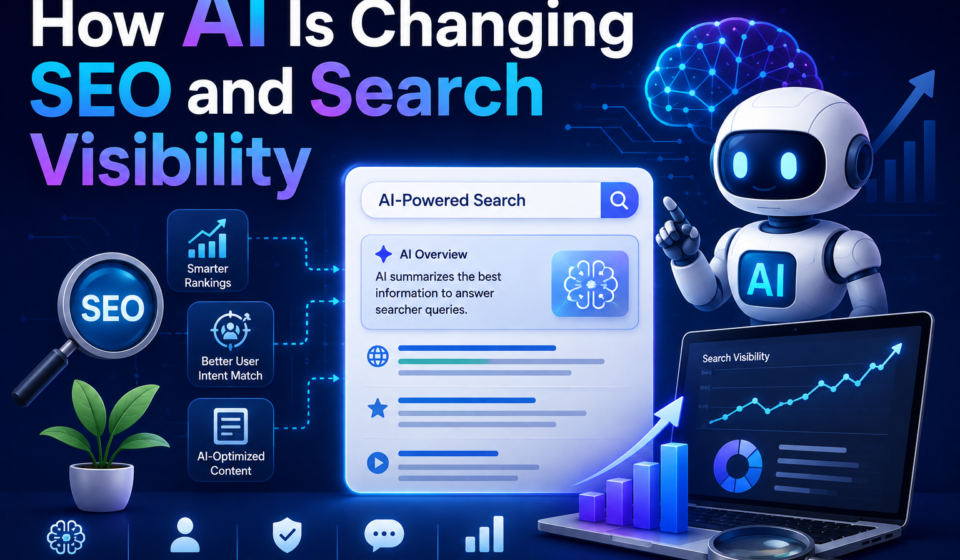

Search visibility is changing as artificial intelligence becomes a larger part of how people discover information online. Traditional search engines have already evolved beyond simple keyword matching, while AI powered search experiences can now understand questions, summarize information, compare sources, and provide direct answers.
For businesses, this shift changes what it means to be visible online. Ranking a webpage for a keyword remains important, but search visibility increasingly depends on whether a brand can be understood, trusted, referenced, and surfaced across different search experiences.
AI is not replacing search optimization. It is changing what effective optimization looks like.
Search Is Becoming More Conversational
Traditional searches often consisted of short phrases such as “best CRM software” or “digital marketing agency.”
AI powered search allows users to ask much more detailed questions.
Someone might ask which CRM is suitable for a growing consulting company, what features matter for a small sales team, and which platforms are easiest to implement.
The search system has to understand the context behind the question rather than simply matching individual words.
This creates an opportunity for businesses that publish detailed, genuinely useful content.
Instead of optimizing a page around one keyword, businesses can address the broader questions customers ask before, during, and after making a decision.
Search Engines Are Better at Understanding Context
Artificial intelligence helps search systems understand relationships between words, concepts, entities, and user intent.
A page does not necessarily need to repeat the exact phrase a user searches for to be considered relevant.
Search systems can recognize related concepts and understand the subject of a page through context.
This makes outdated keyword stuffing strategies less useful.
A stronger approach is to build comprehensive content around a topic and explain important concepts naturally.
For example, a page about business accounting software could discuss invoicing, expense tracking, financial reporting, integrations, tax preparation, user permissions, and reporting workflows.
The content becomes useful because it covers the subject rather than repeatedly repeating a target phrase.
AI Overviews Change the Search Experience
AI generated answers can appear directly within search results, giving users information before they visit a traditional webpage.
This creates a new challenge for businesses.
A company may rank well for a search query but still receive less traffic if users obtain enough information directly from an AI generated response.
At the same time, appearing as a cited or recommended source within an AI answer can provide valuable visibility.
This means businesses need to think beyond traditional rankings.
The question is increasingly not only, “Where does my page rank?”
It is also, “Is my brand visible when AI systems answer questions related to my industry?”
Brand Mentions Are Becoming More Important
Search visibility increasingly involves entities and brands rather than isolated webpages.
AI systems may identify companies, products, experts, publications, organizations, and other entities while generating answers.
A business with a strong online presence across credible sources is easier for search systems to understand.
This makes brand building an important part of modern search strategy.
Businesses can strengthen their digital presence through high quality content, industry publications, expert contributions, customer reviews, company profiles, interviews, research, partnerships, and other legitimate sources of recognition.
The objective is to create a consistent and trustworthy representation of the brand across the web.
Topical Authority Matters
Publishing hundreds of unrelated articles does not necessarily create strong search visibility.
AI driven search systems are increasingly capable of understanding whether a website demonstrates meaningful expertise around a subject.
A business can strengthen topical authority by developing interconnected content around its core areas of expertise.
For example, a fintech company could create comprehensive resources covering digital payments, financial technology, banking innovation, payment security, business finance, and related topics.
Each article can address a specific question while contributing to a broader body of knowledge.
This approach creates depth instead of simply increasing the number of pages.
Content Quality Is Becoming More Important
AI can generate large volumes of content quickly. This means the internet can become saturated with generic articles that provide little original value.
As content volume increases, useful differentiation becomes more important.
Businesses should focus on original insights, real examples, expert opinions, customer experiences, research, data, case studies, and practical explanations.
A page that simply repeats information already available across hundreds of websites may struggle to stand out.
AI can assist with research and content development, but businesses still need human judgment and expertise to create content worth referencing.
Firsthand Experience Creates Differentiation
Readers increasingly want information based on real experience.
A software review written from actual product usage can provide details that a generic summary cannot. A business guide based on real customer situations can offer practical insights that are difficult to reproduce.
Firsthand experience can include screenshots, examples, implementation lessons, case studies, testing results, customer observations, and expert commentary.
These details make content more useful and help demonstrate that the publisher understands the subject.
Structured Content Helps AI Understand Information
Clear content structure can make information easier for both people and machines to understand.
Descriptive headings, concise explanations, lists, tables, definitions, FAQs, and logical organization can improve readability.
Structured data can also help search engines understand specific information about pages, organizations, products, events, and other entities when implemented correctly.
The goal should not be to add structured elements simply for technical reasons.
They should accurately represent information already present on the page.
Long Tail Questions Are Becoming Valuable
AI search encourages users to ask detailed questions.
This creates opportunities around long tail searches.
Instead of focusing exclusively on broad topics such as “startup marketing,” businesses can answer more specific questions such as how a startup can build its first marketing funnel, which channels are appropriate for a limited budget, or how founders can measure early marketing performance.
Specific questions often reveal strong intent.
Creating content around these questions can help businesses reach audiences at different stages of the decision process.
Internal Linking Becomes More Strategic
A strong internal linking structure helps users and search systems discover related information.
A detailed guide can link to supporting articles that explain specific concepts in greater depth.
For example, a central article about SaaS marketing could connect to resources about customer acquisition, onboarding, retention, pricing, content marketing, and product led growth.
This creates relationships between pages and helps visitors navigate the site’s knowledge.
Internal links should be useful and natural rather than added simply to increase the number of links on a page.
Reviews and Third Party Information Matter
Businesses do not control everything that appears about their brand online.
AI systems can encounter information from websites, publications, directories, reviews, industry discussions, and other sources.
This means businesses should pay attention to their broader digital footprint.
Accurate company information, legitimate customer reviews, reputable business profiles, industry coverage, and consistent brand details can help create a clearer online identity.
A strong website is important, but it is only one part of overall search visibility.
Technical SEO Still Matters
The rise of AI does not make technical SEO irrelevant.
Search engines still need to discover, crawl, understand, and access websites.
Page performance, mobile usability, indexing, site architecture, redirects, canonicalization, broken links, security, and other technical factors remain important.
A business should therefore avoid treating AI visibility as a replacement for technical SEO.
Instead, traditional technical foundations and newer content and brand strategies should work together.
AI Can Improve SEO Workflows
Artificial intelligence can also help businesses improve their own search optimization processes.
AI tools can assist with content research, topic discovery, query analysis, content briefs, information organization, competitor analysis, summarization, and content audits.
They can help identify patterns across large amounts of information much faster than manual analysis.
However, automation should support strategy rather than replace it.
Human review remains important for accuracy, originality, brand positioning, factual claims, and customer relevance.
Search Visibility Is Becoming Multichannel
People no longer rely on a single search interface.
They may discover brands through traditional search results, AI assistants, social platforms, video platforms, review websites, business directories, communities, newsletters, and industry publications.
AI can connect information from different parts of this ecosystem.
This means businesses should consider their overall digital presence rather than focusing exclusively on one search engine.
A company with consistent information and strong credibility across multiple channels has more opportunities to be discovered.
Optimize for Questions and Intent
Modern search optimization should begin with understanding what the user is trying to accomplish.
Someone searching for a product may want to compare options. Another person may want to understand a concept. Someone else may be ready to contact a provider.
The content should reflect that intent.
Educational searches require explanations. Comparison searches require clear differences. Commercial searches require product information, evidence, and trust. Transactional searches require an easy path to action.
Matching content to intent creates a better experience and improves the likelihood that the page will be useful.
Build Content That Can Be Referenced
AI systems need reliable information to construct useful answers.
Businesses can increase their chances of being referenced by publishing clear, authoritative, factual, and distinctive information.
Original research can be particularly valuable.
A company that publishes useful industry statistics, benchmarks, surveys, research findings, or expert analysis can become a source that other websites and AI systems can draw from.
This moves content marketing beyond simply attracting visitors.
It creates information that others may use as a reference.
Keep Content Accurate and Current
AI powered search can make outdated information more problematic because incorrect information can spread quickly.
Businesses should periodically review important content.
Update statistics, product information, regulations, examples, pricing, links, and recommendations when necessary.
Older content does not always need to be replaced. In many cases, updating a strong existing resource is more useful than creating another article on the same subject.
Accuracy strengthens trust with both users and search systems.
Measure Visibility Beyond Rankings
Traditional SEO reports often focus on keyword rankings and organic traffic.
Those metrics remain useful, but businesses can expand measurement to include brand searches, referral traffic, conversions, content engagement, mentions, citations, and visibility across AI powered search experiences.
The goal is to understand whether search visibility is contributing to business outcomes.
A page receiving fewer visits but generating highly qualified leads can be more valuable than a page receiving thousands of visitors with little commercial relevance.
The Future of SEO Is About Being Understandable and Trusted
Artificial intelligence is changing how search systems discover and present information, but the underlying objective remains similar.
Search systems want to connect people with useful information.
Businesses that clearly explain what they do, demonstrate expertise, publish useful information, maintain accurate digital profiles, and build genuine authority will be better positioned for this changing environment.
The future of SEO is therefore not simply about adding more keywords or producing more pages.
It is about becoming a reliable source of information that search engines, AI systems, customers, and other websites can understand and trust.
Frequently Asked Questions
Is AI replacing traditional SEO?
No. AI is changing how search works, but traditional SEO foundations such as technical accessibility, useful content, relevant links, search intent, and website quality remain important.
What is AI search visibility?
AI search visibility refers to how often a brand, website, product, or expert appears within AI generated answers, recommendations, summaries, and other AI powered discovery experiences.
How can businesses appear in AI generated answers?
Businesses can improve their chances by creating authoritative content, maintaining accurate brand information, publishing original research, demonstrating expertise, earning legitimate third party coverage, and clearly explaining their products and services.
Is keyword research still important?
Yes. Keyword research can reveal what people are searching for and the language they use. However, modern content strategies should focus on topics, questions, context, and user intent rather than keyword repetition.
Does AI generated content hurt SEO?
AI generated content is not automatically harmful. The bigger concern is content that is inaccurate, repetitive, generic, or created primarily to manipulate search rankings. Content should provide genuine value and be reviewed for quality and accuracy.
What is the difference between SEO and AI visibility?
SEO traditionally focuses on improving visibility within search engine results. AI visibility focuses more broadly on whether a brand or source is recognized and represented within AI generated search experiences and answers.
Why is brand authority important for AI search?
AI systems need to identify entities and evaluate information from different sources. A consistent presence across reputable websites, publications, reviews, profiles, and other channels can make a business easier to understand and recognize.
Should businesses focus on long form content?
Length alone does not determine quality. A detailed article can be valuable when the subject requires depth, but concise content may be better for straightforward questions. The priority should be completeness, usefulness, accuracy, and relevance.
How often should SEO content be updated?
Important content should be reviewed whenever significant information changes. Businesses can also schedule periodic reviews for pages containing statistics, product information, regulations, pricing, or industry developments.
What SEO metrics should businesses track?
Useful metrics include organic traffic, rankings, conversions, qualified leads, brand searches, engagement, backlinks, mentions, referral traffic, and visibility across relevant AI search experiences.
Can small businesses benefit from AI search?
Yes. Smaller businesses can compete by developing specialized expertise and highly useful content around focused topics. A clear niche can make it easier to establish authority than trying to compete broadly across an entire industry.
What is the most important SEO strategy in the AI era?
Create information that is genuinely useful, accurate, original, and easy to understand. Businesses should combine strong technical foundations with topical expertise, trustworthy brand signals, and content that directly addresses real customer questions.