
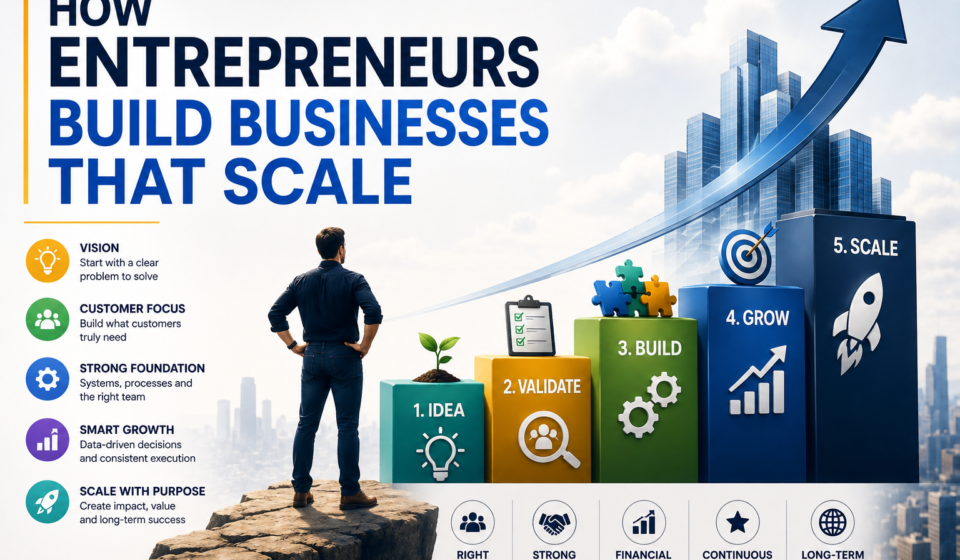

Building a business that generates revenue is one challenge. Building a business that can grow significantly without becoming inefficient, chaotic, or financially unstable is another.
Scalable businesses are designed so that revenue can increase without operating costs, complexity, and founder involvement increasing at the same rate. This does not mean every scalable company is highly automated from the beginning. It means entrepreneurs intentionally create products, processes, teams, and systems that can support increasing demand.
Successful scaling usually starts long before a company becomes large. The decisions made during the early stages determine whether growth becomes an opportunity or a source of operational problems.
Start With a Repeatable Business Model
A scalable company needs a business model that can be repeated.
Entrepreneurs should understand exactly how the company creates value, acquires customers, delivers its product or service, and generates revenue.
If every customer requires a completely different process, scaling can become difficult. Customization may be valuable, but excessive customization can increase delivery costs and management complexity.
A repeatable model allows entrepreneurs to standardize important parts of the customer journey.
For example, a software company can serve thousands of customers without creating a completely new product for every customer. A consulting company may develop standardized service packages, processes, and delivery frameworks that allow it to serve more clients efficiently.
The goal is not to remove flexibility. It is to create consistency around the parts of the business that can be repeated.
Solve a Problem With Growing Demand
A scalable business needs a market that can support expansion.
Entrepreneurs should evaluate whether the problem they are solving affects enough customers and whether demand is likely to remain strong as the company grows.
A niche market can still support a highly successful company, especially when customers have a strong willingness to pay. The important question is whether the opportunity is large enough for the company’s ambitions.
Market demand should be tested through customer conversations, sales, usage data, competitive research, and actual purchasing behavior.
Growth becomes much easier when the company is operating in a market where customers already recognize the problem and actively seek solutions.
Build a Product That Can Handle Growth
Products should be designed with future customers in mind.
For software companies, this may involve infrastructure that can handle increasing users, reliable systems, security controls, and efficient support processes.
For physical businesses, scalability may depend on manufacturing capacity, supply chains, inventory management, logistics, and distribution.
For service companies, scalability may require standardized delivery methods, training systems, specialized teams, and technology.
The specific requirements differ by industry, but the principle remains the same.
Entrepreneurs should identify what could break if demand suddenly doubles or triples and address those weaknesses before they become serious constraints.
Standardize Repetitive Processes
When a company is small, founders often handle tasks through personal knowledge.
They may know how to onboard customers, prepare proposals, respond to support requests, manage invoices, or complete operational tasks without documenting the process.
This works for a small business but becomes difficult as the team grows.
Standard operating procedures can turn individual knowledge into repeatable systems.
Documentation does not need to be complicated. A clear checklist, workflow, template, or short guide can be enough to help another employee complete the task correctly.
Standardization improves consistency and makes expansion easier.
Use Technology to Increase Capacity
Technology can allow businesses to serve more customers without increasing headcount at the same rate.
Automation can handle repetitive tasks such as appointment scheduling, email notifications, reporting, invoicing, data entry, lead routing, and customer onboarding.
Customer relationship management systems can organize sales activities. Project management platforms can coordinate teams. Analytics tools can provide visibility into business performance.
Artificial intelligence can also assist with research, customer communication, content development, data analysis, and administrative workflows.
Technology should be introduced where it removes meaningful bottlenecks.
Adding software simply because it is popular can create unnecessary complexity.
Create a Strong Customer Acquisition System
A business cannot scale without a reliable way to acquire customers.
Entrepreneurs should identify acquisition channels that can generate customers consistently.
These may include organic search, content marketing, referrals, partnerships, direct sales, social media, paid advertising, events, email marketing, or industry communities.
The ideal mix depends on the business.
The important point is to develop repeatable acquisition rather than depending entirely on the founder’s personal network.
A company that can consistently attract qualified prospects has a stronger foundation for growth.
Focus on Customer Retention
Acquiring customers is only part of scaling.
If customers leave quickly, the company must continuously replace them.
Strong retention makes growth more efficient because existing customers continue generating revenue while the business acquires new ones.
Entrepreneurs can improve retention by providing strong onboarding, reliable customer support, consistent product quality, useful education, and regular communication.
They should also understand why customers leave.
Churn can reveal product weaknesses, pricing problems, poor onboarding, unmet expectations, or changing customer needs.
Build Around Customer Lifetime Value
Scalable companies need to understand how much value customers generate over time.
Customer lifetime value can be influenced by initial purchase size, subscription duration, repeat purchases, upgrades, cross selling, and referrals.
Increasing customer lifetime value can make acquisition more sustainable.
For example, a SaaS company might offer additional features or higher tier plans as customers grow. A service business might introduce complementary services that solve related problems.
The objective is not to sell unnecessary products.
It is to continue providing relevant value as customer needs evolve.
Hire People Who Increase Capacity
Scaling requires people, but hiring too quickly can create unnecessary expenses.
Entrepreneurs should hire when there is a clear business need and when the new role can increase capacity, improve quality, or remove an important constraint.
Early employees often have broad responsibilities. As the company grows, roles can become more specialized.
Strong hiring also requires clear expectations.
Employees need to understand their responsibilities, decision making authority, performance expectations, and how their work contributes to company goals.
A scalable team is not simply a larger team. It is a team that can operate effectively without constant founder intervention.
Delegate Before the Founder Becomes the Bottleneck
Many entrepreneurs struggle to delegate because they are accustomed to controlling important decisions.
This can become a serious limitation.
If every customer issue, hiring decision, marketing campaign, product change, or operational question requires the founder’s approval, the business cannot grow efficiently.
Entrepreneurs should gradually transfer responsibility to capable team members.
Delegation works best when employees receive both authority and accountability.
The founder can establish clear boundaries while allowing people to make decisions within their areas of responsibility.
Develop Strong Financial Controls
Growth can create financial pressure even when revenue is increasing.
Hiring, inventory, technology, marketing, facilities, and expansion can require significant upfront spending.
Entrepreneurs should monitor cash flow, margins, operating costs, customer acquisition costs, recurring revenue, and profitability.
Financial planning helps determine how quickly the company can expand without creating unnecessary risk.
A growing business should not assume that higher revenue automatically means better financial health.
The quality of revenue matters.
Protect Profit Margins
A company can grow rapidly while becoming less profitable.
Entrepreneurs should understand which products, customers, services, and acquisition channels generate healthy margins.
If serving a particular customer requires excessive customization or support, the company may need to reconsider pricing or delivery.
Improving operational efficiency can increase margins without raising prices.
Strong margins provide more resources for reinvestment and create greater resilience during difficult periods.
Build a Brand That Customers Recognize
Brand strength can support scalability by making customer acquisition easier.
A recognizable company can benefit from referrals, repeat purchases, organic search, media attention, partnerships, and customer trust.
Brand building is not limited to visual identity.
It includes positioning, customer experience, communication, reputation, product quality, and the promises the company consistently delivers.
A strong brand reduces the amount of explanation required when potential customers encounter the company for the first time.
Use Data to Guide Decisions
Entrepreneurs need reliable information as the business grows.
Important metrics may include revenue growth, customer acquisition cost, conversion rates, retention, churn, gross margins, average order value, employee productivity, and cash flow.
The right metrics depend on the business model.
The purpose of measurement is not to create complicated dashboards.
It is to understand what is working, identify problems early, and make better decisions.
Data should support judgment rather than replace it.
Create Multiple Growth Paths
A scalable company can often grow through several mechanisms.
It may acquire more customers, increase customer spending, enter new markets, introduce additional products, develop partnerships, or expand distribution.
Entrepreneurs should avoid pursuing every opportunity simultaneously.
A strong core business should usually come first.
Once the foundation is stable, the company can test additional growth opportunities without distracting the team from its main source of revenue.
Expand Only After the Core Model Works
Entering new markets can be tempting when the original business begins to gain traction.
However, expansion can expose weaknesses.
Before entering another market, entrepreneurs should understand whether the product, pricing, customer acquisition strategy, support model, and operations can transfer successfully.
Expansion should be based on evidence rather than excitement.
A company that has not yet developed a strong operating model may simply multiply its existing problems by entering new markets.
Make the Business Less Dependent on Individuals
A scalable company should not rely entirely on one founder or employee knowing how everything works.
Important information should be documented. Customer relationships should be recorded in appropriate systems. Processes should be accessible to relevant employees.
This creates organizational resilience.
If one person leaves, the company should be able to continue operating.
Reducing individual dependency also makes it easier to train new employees and expand teams.
Build a Culture That Supports Growth
Culture becomes increasingly important as the company grows.
Early teams often communicate informally because everyone works closely together. Larger organizations need clearer expectations around collaboration, accountability, decision making, customer service, and communication.
Entrepreneurs should define the behaviors they want the company to maintain as it expands.
A growth focused culture should encourage learning, ownership, responsible experimentation, and customer awareness.
Continue Improving the Business Model
Scalability is not a one time achievement.
Markets change, technologies evolve, competitors introduce new products, and customer expectations shift.
Entrepreneurs should regularly review their business model and ask whether the company is still operating efficiently.
Processes that worked with twenty employees may need to change with two hundred.
The ability to adapt is itself a form of scalability.
Conclusion
Entrepreneurs build scalable businesses by creating systems that allow the company to grow without increasing complexity at the same rate.
A repeatable business model, strong customer demand, reliable acquisition channels, high retention, standardized processes, effective technology, capable teams, financial discipline, and clear decision making all contribute to sustainable scalability.
The goal is not simply to become bigger.
A truly scalable business becomes more capable as it grows. Its processes improve, its team becomes stronger, its customer base expands, and its systems allow increasing demand to be handled efficiently.
Entrepreneurs who design for scalability early can avoid many of the operational problems that appear when growth arrives unexpectedly. Instead of constantly reacting to new challenges, they build a business structure that is prepared to handle them.