
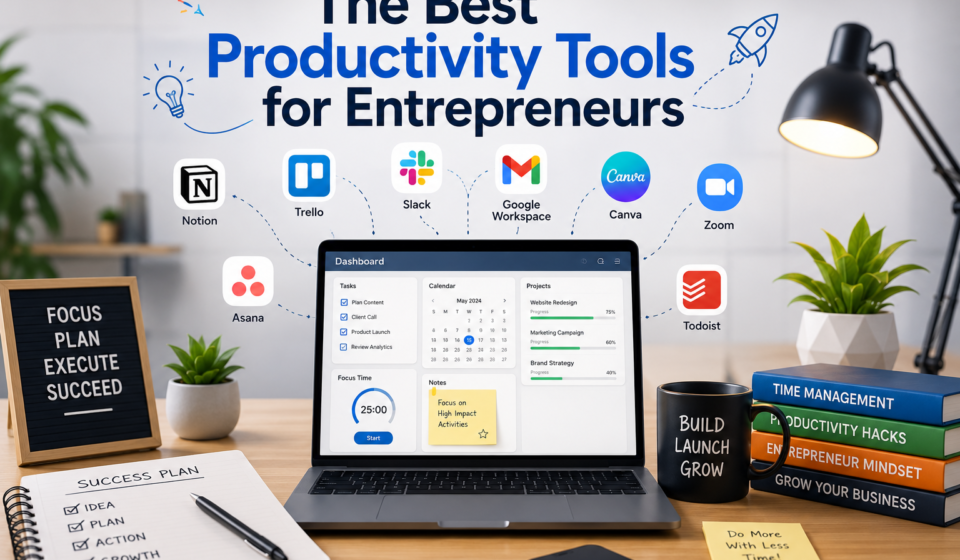

Entrepreneurs manage a unique combination of responsibilities. They may move between strategy, sales, customer communication, finance, hiring, marketing, operations, and product development within the same day. Without the right systems, important tasks can quickly become difficult to track.
Productivity tools can help entrepreneurs organize work, reduce repetitive tasks, communicate with teams, and make better use of limited time. However, productivity is not about collecting dozens of applications. The most effective setup usually combines a small number of tools that solve specific problems and work well together.
Project Management Tools
Project management platforms help entrepreneurs organize tasks, deadlines, projects, and team responsibilities in one place.
Tools such as Trello, Asana, ClickUp, and Monday.com provide different approaches to project organization. Some are designed around simple task boards, while others provide detailed project planning, workflow automation, reporting, and team management.
A good project management system can answer basic questions quickly:
What needs to be done?
Who is responsible?
When is it due?
What is currently blocked?
What has already been completed?
For small businesses, this visibility can prevent tasks from being forgotten and reduce unnecessary meetings.
Note Taking and Knowledge Management
Entrepreneurs collect information constantly. Meeting notes, business ideas, customer feedback, research, strategies, and important documents can quickly become scattered across different applications.
Knowledge management tools such as Notion, Evernote, and Microsoft OneNote can provide a central location for organizing information.
A well structured knowledge system can include company procedures, meeting notes, project documentation, research, content ideas, customer information, and internal resources.
The value comes from being able to find information quickly rather than repeatedly searching through emails and chat messages.
Communication Platforms
Fast communication is essential for distributed teams and growing businesses.
Slack, Microsoft Teams, and similar platforms allow teams to communicate without relying entirely on email. Conversations can be organized by projects, departments, customers, or specific topics.
However, communication tools can also become distracting. Entrepreneurs should establish clear expectations around channels, notifications, urgent requests, and response times.
Not every message requires an immediate response.
A productive communication system protects focused work while still keeping the team connected.
Calendar and Scheduling Tools
Time is one of the most limited resources for an entrepreneur. Calendar tools can help protect that resource.
Google Calendar, Microsoft Outlook, and scheduling platforms such as Calendly can simplify meeting coordination.
Entrepreneurs can create dedicated blocks for strategic work, customer meetings, administration, and personal commitments.
Scheduling tools can also reduce unnecessary back and forth when arranging meetings with clients or partners.
The most useful calendar is not simply a record of appointments. It should reflect how the entrepreneur intends to spend their time.
Time Tracking Tools
Time tracking can reveal where working hours actually go.
Tools such as Toggl Track and Harvest can help entrepreneurs understand how much time is spent on clients, internal projects, meetings, administration, and other activities.
This information can be particularly useful for service businesses.
If a project repeatedly requires more time than expected, the entrepreneur can review pricing, scope, staffing, or processes.
Time tracking can also reveal activities that consume significant time without producing meaningful business value.
Accounting and Financial Management Tools
Financial organization is essential for entrepreneurial productivity.
Accounting platforms such as QuickBooks, Xero, and FreshBooks can help manage invoices, expenses, financial records, payments, and reporting.
Keeping financial information organized reduces the amount of manual administration required and makes it easier to understand the company’s financial position.
Entrepreneurs should still review financial information regularly. Automation can reduce repetitive work, but financial decisions require human judgment.
Customer Relationship Management Tools
Customer relationship management systems help entrepreneurs organize leads, prospects, customers, sales opportunities, and communications.
Platforms such as HubSpot, Salesforce, and Zoho CRM can provide visibility into the sales pipeline.
Instead of keeping customer information in spreadsheets or personal notes, a CRM can create a structured record of interactions.
For growing businesses, this can prevent leads from being forgotten and help sales teams understand where each opportunity stands.
A CRM becomes especially valuable when multiple people are involved in customer relationships.
Email Productivity Tools
Email can consume a significant portion of an entrepreneur’s working day.
Email management features and tools can help organize messages, schedule responses, create templates, and reduce repetitive communication.
Entrepreneurs can also establish specific periods for checking email instead of keeping their inbox open continuously.
Templates are particularly useful for recurring messages such as introductions, meeting confirmations, customer updates, proposals, and follow ups.
The objective is not to answer every email immediately. It is to make email communication more predictable and efficient.
Automation Tools
Automation platforms can connect different applications and reduce repetitive tasks.
Tools such as Zapier and Make allow businesses to create workflows between applications.
For example, a new form submission could automatically create a CRM contact, notify the sales team, and add the lead to a follow up workflow.
Automation is most useful when it removes repetitive administrative work.
Entrepreneurs should first understand a process before automating it. Automating an inefficient process can simply make inefficiency happen faster.
Cloud Storage and File Management
Cloud storage platforms such as Google Drive, Microsoft OneDrive, and Dropbox make business files accessible across devices and teams.
A clear folder structure is essential.
Files should have consistent naming conventions and logical locations. Important documents should not depend on one person’s computer.
Cloud based file management also makes collaboration easier because multiple team members can work with shared documents without constantly exchanging attachments.
Password Management Tools
Security is another important part of productivity.
Entrepreneurs often manage numerous business accounts, software subscriptions, financial platforms, social media profiles, and administrative systems.
Password managers such as 1Password and Bitwarden can help store credentials securely and generate stronger passwords.
They can also make it easier to manage access when employees or contractors join and leave the company.
Good security practices reduce the risk of losing access to important business systems.
AI Productivity Tools
Artificial intelligence has become an increasingly useful productivity resource for entrepreneurs.
AI tools can assist with research, brainstorming, summarizing documents, drafting communications, analyzing information, preparing meeting notes, creating content, and developing first drafts.
The greatest value usually comes from using AI to accelerate repetitive or time consuming work while keeping human review in the process.
Entrepreneurs should avoid treating AI output as automatically accurate. Important financial, legal, strategic, and customer facing information should be reviewed before use.
Used thoughtfully, AI can allow small teams to accomplish work that previously required significantly more time or resources.
Design and Content Creation Tools
Entrepreneurs frequently need marketing materials, presentations, social media graphics, sales documents, and other visual assets.
Tools such as Canva and Adobe Express make it easier for small teams to create professional looking materials without depending on a designer for every small requirement.
For more advanced design work, professional creative software can provide greater control.
The right choice depends on how frequently the business creates visual content and how complex those projects are.
Passwords, Documents, and Processes Should Work Together
One of the biggest productivity improvements comes from connecting tools rather than simply adding more tools.
For example, a sales process might connect a website form with a CRM, scheduling platform, email system, and project management application.
When these systems communicate properly, information can move automatically between stages.
The entrepreneur spends less time transferring information manually and more time making decisions.
Avoid Building an Overcomplicated Tool Stack
More software does not automatically create more productivity.
Every additional platform introduces another login, notification system, subscription, learning curve, and potential source of confusion.
Entrepreneurs should regularly review their software stack.
If two tools perform nearly identical functions, consider whether one can be removed. If a platform is rarely used, evaluate whether it is actually necessary.
A simple system that employees understand is often more valuable than an advanced system that nobody uses consistently.
Choose Tools Based on Business Needs
The best productivity tools depend on the entrepreneur’s business model.
A freelancer may need accounting, scheduling, project management, and time tracking. A technology startup may need development management, customer support, analytics, communication, and collaboration tools. A consulting company may place greater emphasis on CRM, proposals, scheduling, document management, and client communication.
There is no universal productivity stack.
Entrepreneurs should identify their biggest operational problems first and then select tools that directly address those problems.
Create Standard Workflows
Tools become significantly more valuable when combined with repeatable processes.
For example, a company can create a standard workflow for onboarding a new customer. Once the contract is signed, the CRM can be updated, the project created, the welcome email sent, required documents collected, and the internal team notified.
This reduces the amount of decision making required for routine activities.
Standard workflows also make it easier to train new employees.
Review Productivity Systems Regularly
Business needs change as companies grow.
A tool that worked well for a team of three may become inadequate for a team of thirty. Similarly, an expensive platform may not be necessary during the early stages of a business.
Entrepreneurs should periodically review their tools and processes.
Ask whether the system saves time, improves visibility, reduces errors, supports collaboration, or contributes to revenue.
If it does none of these things, it may not deserve a place in the business.
Conclusion
Productivity tools can help entrepreneurs manage complexity, but software alone does not create productivity. The real advantage comes from combining appropriate tools with clear processes, focused priorities, and disciplined working habits.
Project management platforms can organize responsibilities. Communication tools can keep teams connected. CRMs can manage customer relationships. Accounting platforms can simplify financial administration. Automation can eliminate repetitive tasks, while AI can accelerate research and content creation.
The strongest productivity setup is usually not the one with the most applications. It is the system that makes important work easier to complete, information easier to find, and business decisions easier to make.
For entrepreneurs, the right productivity tools should ultimately create something more valuable than a well organized dashboard. They should create more time for strategy, customers, innovation, and the work that actually moves the business forward.