
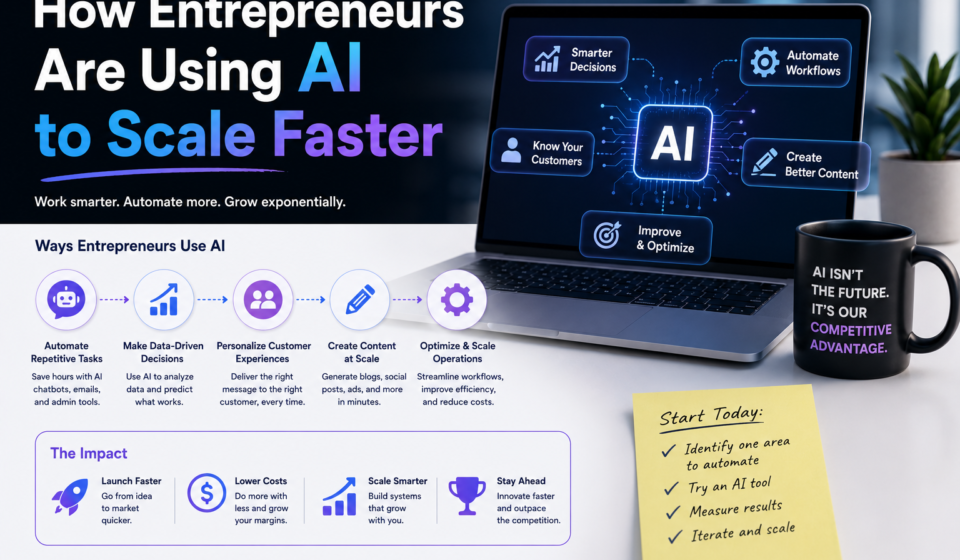

The business landscape has changed dramatically over the last few years, and artificial intelligence has emerged as one of the most powerful tools entrepreneurs can use to accelerate growth. What once required large teams, significant capital investment, and years of operational experience can now be accomplished faster and more efficiently through AI-powered solutions. From automating repetitive tasks to improving customer experiences and making data-driven decisions, entrepreneurs across industries are leveraging artificial intelligence to scale their businesses at unprecedented speeds.
For startups and small businesses, scaling has traditionally been associated with hiring more employees, increasing operational costs, and expanding infrastructure. However, AI is changing this equation by enabling founders to do more with fewer resources. Entrepreneurs who strategically implement AI technologies are discovering that they can increase productivity, improve efficiency, reduce expenses, and unlock new revenue opportunities without sacrificing quality.
As competition intensifies in nearly every industry, understanding how entrepreneurs are using AI to scale faster has become essential for founders, startup leaders, and business owners seeking sustainable growth. This article explores the various ways AI is transforming entrepreneurship, the tools businesses are using, the benefits of AI adoption, and the strategies entrepreneurs can implement to scale successfully.
The Rise of AI in Entrepreneurship
Artificial intelligence has evolved from a futuristic concept into a practical business necessity. The accessibility of AI tools has allowed businesses of all sizes to integrate advanced technologies into their daily operations. Entrepreneurs no longer need specialized technical teams or massive budgets to take advantage of AI capabilities.
The widespread availability of cloud-based AI platforms, generative AI tools, machine learning applications, and automation software has created opportunities for startups to compete with larger organizations. Entrepreneurs are increasingly using AI to streamline operations, improve decision-making, and create personalized customer experiences.
The adoption of AI is particularly attractive to startups because it addresses one of their biggest challenges: limited resources. By automating tasks that previously required human labor, founders can focus on strategic growth initiatives while maintaining operational efficiency.
Why AI Is Becoming Essential for Business Growth
Modern businesses operate in environments characterized by rapid change, increased customer expectations, and intense competition. AI offers entrepreneurs the ability to adapt quickly while maintaining operational excellence.
Artificial intelligence helps businesses process vast amounts of data, identify patterns, predict outcomes, and automate complex workflows. These capabilities enable entrepreneurs to make better decisions and respond faster to market changes.
Businesses that delay AI adoption risk falling behind competitors who leverage technology to increase productivity and reduce costs. For entrepreneurs seeking rapid growth, AI is no longer an optional enhancement but a critical competitive advantage.
Key Areas Where Entrepreneurs Are Using AI to Scale
Entrepreneurs are implementing AI across multiple business functions to accelerate growth and improve performance. The versatility of AI allows businesses to optimize operations throughout the entire customer journey.
| Business Function | AI Application | Primary Benefit | Impact on Scaling |
|---|---|---|---|
| Marketing | Content generation and personalization | Increased customer engagement | Faster market expansion |
| Sales | Lead scoring and predictive analytics | Higher conversion rates | Improved revenue growth |
| Customer Service | AI chatbots and virtual assistants | Reduced support costs | Enhanced customer satisfaction |
| Operations | Workflow automation | Increased efficiency | Lower operational expenses |
| Finance | Forecasting and analytics | Better financial decisions | Improved resource allocation |
| Human Resources | Recruitment automation | Faster hiring | Accelerated team growth |
| Product Development | Customer insights analysis | Better product-market fit | Faster innovation cycles |
AI-Powered Marketing for Rapid Business Growth
Marketing has become one of the most significant areas where entrepreneurs use AI to scale faster. Traditional marketing methods often require substantial budgets and large teams. AI-powered marketing tools enable startups to compete effectively with established brands.
Entrepreneurs are using AI to generate high-quality content, optimize search engine strategies, personalize customer experiences, and automate advertising campaigns. AI can analyze consumer behavior patterns and identify the most effective marketing channels, allowing businesses to allocate resources more efficiently.
Content creation tools powered by artificial intelligence help entrepreneurs produce blog posts, social media content, email campaigns, and marketing materials at scale. This increased efficiency allows businesses to maintain consistent communication with their audiences while reducing production costs.
AI-driven analytics platforms also provide deeper insights into customer behavior, enabling entrepreneurs to create highly targeted marketing campaigns that improve conversion rates and customer retention.
Leveraging AI for Customer Acquisition
Acquiring customers is one of the most challenging aspects of scaling a business. Entrepreneurs are increasingly relying on AI to optimize customer acquisition strategies and reduce acquisition costs.
AI-powered customer relationship management systems can identify high-value prospects, predict customer behavior, and prioritize leads based on their likelihood of conversion. These systems help sales teams focus their efforts on opportunities with the greatest revenue potential.
Predictive analytics enables entrepreneurs to understand customer preferences and buying patterns. By analyzing historical data, AI can forecast future purchasing behavior and recommend personalized marketing approaches.
Chatbots and conversational AI tools have also become valuable assets for customer acquisition. These technologies engage visitors in real time, answer questions, qualify leads, and guide prospects through the sales funnel without requiring human intervention.
Automating Operations to Improve Efficiency
Operational efficiency is a critical factor in business scalability. Entrepreneurs often struggle with managing increasing workloads while maintaining quality standards. AI automation provides a solution by eliminating repetitive tasks and reducing human error.
Business owners are using AI to automate administrative tasks such as scheduling, invoicing, inventory management, and reporting. Automation reduces operational bottlenecks and allows employees to focus on strategic activities that drive growth.
AI-powered workflow management systems can analyze business processes and identify areas for improvement. These systems continuously optimize operations, helping businesses maintain efficiency as they expand.
Supply chain management is another area where entrepreneurs benefit from AI. Predictive algorithms can forecast demand, optimize inventory levels, and reduce operational costs, enabling businesses to scale more effectively.
Enhancing Customer Experience Through AI
Customer experience has become a major differentiator in competitive markets. Entrepreneurs are using AI to deliver personalized experiences that improve customer satisfaction and increase loyalty.
Artificial intelligence enables businesses to analyze customer preferences, purchase histories, and behavioral patterns to provide tailored recommendations and personalized communications. This level of personalization strengthens customer relationships and drives repeat business.
AI-powered customer support systems operate around the clock, ensuring customers receive immediate assistance regardless of time zone or business hours. These systems can handle a significant portion of customer inquiries, reducing support costs while improving response times.
Sentiment analysis tools also help entrepreneurs understand customer feedback and identify areas requiring improvement. By continuously monitoring customer sentiment, businesses can proactively address concerns and maintain strong customer relationships.
Data-Driven Decision Making With AI
Successful scaling requires informed decision-making. Entrepreneurs increasingly rely on AI to analyze large volumes of data and generate actionable insights.
Artificial intelligence can process information far more quickly than traditional analytical methods. This capability allows entrepreneurs to identify trends, evaluate performance metrics, and forecast business outcomes with greater accuracy.
Predictive analytics has become particularly valuable for startups seeking sustainable growth. Entrepreneurs use predictive models to forecast sales, anticipate customer churn, optimize pricing strategies, and evaluate investment opportunities.
AI-driven business intelligence platforms provide real-time insights that enable leaders to respond rapidly to changing market conditions. Faster decision-making often translates into stronger competitive positioning and accelerated growth.
AI in Financial Management and Forecasting
Financial management is a critical component of business scalability. Entrepreneurs are using AI-powered financial tools to improve budgeting, forecasting, and cash flow management.
Artificial intelligence can analyze financial data, identify spending patterns, and predict future revenue trends. These insights help entrepreneurs allocate resources more effectively and minimize financial risks.
AI also assists in fraud detection, expense management, and financial reporting. Automated financial processes reduce administrative workloads while improving accuracy and compliance.
Startups with limited financial expertise particularly benefit from AI-powered financial platforms because they gain access to advanced analytical capabilities without requiring large finance teams.
Accelerating Product Development With AI
Product development cycles have traditionally been lengthy and resource-intensive. AI enables entrepreneurs to accelerate innovation by identifying customer needs and optimizing development processes.
Machine learning algorithms can analyze customer feedback, market trends, and competitor data to identify opportunities for product improvement and innovation. This insight allows businesses to develop products that better align with market demand.
AI-powered prototyping and testing tools also reduce development timelines by automating repetitive processes and identifying potential issues early in the design phase.
Entrepreneurs who integrate AI into product development can launch products faster, reduce costs, and improve their chances of achieving product-market fit.
Building Lean Teams With AI Support
One of the most significant advantages of AI for entrepreneurs is the ability to build lean, highly productive teams. Rather than expanding headcount aggressively, founders can leverage AI tools to increase the productivity of existing employees.
AI assistants help employees manage schedules, organize information, conduct research, and complete administrative tasks. This support allows team members to focus on creative, strategic, and high-value activities.
Recruitment has also been transformed by AI technologies. Entrepreneurs can use AI to screen candidates, analyze resumes, and identify the best talent more efficiently. Faster hiring processes contribute to more rapid organizational growth.
The ability to maintain lean operations while increasing output represents a major competitive advantage for startups seeking scalable business models.
Challenges Entrepreneurs Face When Implementing AI
Despite its benefits, implementing AI presents several challenges. Entrepreneurs must carefully evaluate their business needs and select technologies that align with their strategic goals.
One common challenge is the lack of internal expertise required to deploy and manage AI systems effectively. Businesses may need to invest in employee training or external support services.
Data quality also significantly impacts AI performance. Inaccurate or incomplete data can lead to poor outcomes and ineffective decision-making.
Cost considerations remain relevant, particularly for early-stage startups. Although many AI tools are affordable, businesses must carefully assess return on investment before implementing new technologies.
Additionally, entrepreneurs must address ethical concerns related to privacy, security, and transparency when using AI-powered systems.
Strategies for Successfully Scaling With AI
Entrepreneurs seeking to scale with AI should adopt a strategic approach rather than implementing technology for its own sake. Successful AI adoption begins with identifying specific business challenges that can benefit from automation or enhanced analytics.
Businesses should start with smaller AI initiatives that deliver measurable results before expanding their investments. This approach minimizes risk while building organizational confidence in AI technologies.
Entrepreneurs should also prioritize employee education and encourage teams to embrace AI as a productivity tool rather than a replacement for human expertise.
Continuous evaluation and optimization are essential for maximizing AI performance. Businesses that regularly assess outcomes and adapt their strategies are more likely to achieve sustainable growth.
The Future of AI-Driven Entrepreneurship
Artificial intelligence will continue reshaping entrepreneurship over the coming decade. Advances in machine learning, generative AI, predictive analytics, and automation technologies will create even greater opportunities for businesses to scale rapidly.
Entrepreneurs who adopt AI early and develop strong implementation strategies will likely gain significant competitive advantages. The future of business growth will increasingly depend on an organization’s ability to combine human creativity with artificial intelligence capabilities.
As AI tools become more sophisticated and accessible, entrepreneurs will gain access to technologies that were previously available only to large corporations. This democratization of innovation will continue to transform industries and redefine how businesses achieve scale.
Conclusion
Artificial intelligence has fundamentally changed the way entrepreneurs build and scale businesses. From automating operations and improving customer experiences to enhancing decision-making and accelerating product development, AI provides founders with powerful tools to achieve growth more efficiently.
Entrepreneurs who successfully integrate AI into their business strategies can reduce costs, increase productivity, improve customer satisfaction, and create sustainable competitive advantages. While challenges exist, the potential benefits of AI adoption far outweigh the risks when implemented thoughtfully.
The entrepreneurs who thrive in the coming years will be those who recognize AI not simply as a technology trend but as a strategic growth engine capable of transforming how businesses operate and scale. By embracing artificial intelligence today, founders position themselves for faster growth, greater innovation, and long-term success.
Frequently Asked Questions
How are entrepreneurs using AI to grow their businesses?
Entrepreneurs use AI to automate operations, improve marketing performance, optimize customer acquisition, enhance customer service, analyze business data, and streamline financial management processes.
Can small businesses afford AI tools?
Yes. Many AI platforms offer affordable subscription models designed specifically for startups and small businesses, making advanced technology accessible without requiring large investments.
What business areas benefit most from AI implementation?
Marketing, sales, customer support, operations, finance, human resources, and product development are among the areas that experience the greatest benefits from AI adoption.
Does AI replace employees in startups?
In most cases, AI complements employees rather than replacing them. It automates repetitive tasks and allows team members to focus on strategic, creative, and high-value activities.
What are the risks of implementing AI in business?
Common risks include poor data quality, implementation costs, lack of expertise, security concerns, and potential ethical challenges related to privacy and transparency.
How can entrepreneurs begin using AI effectively?
Entrepreneurs should start by identifying specific business problems, selecting appropriate AI tools, implementing small pilot projects, measuring results, and gradually expanding their use of artificial intelligence.