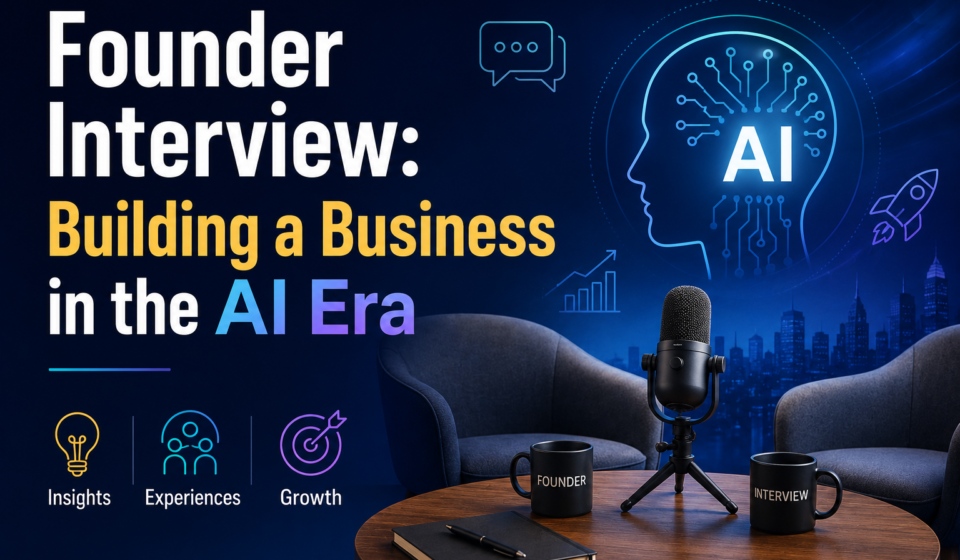

Artificial intelligence is transforming the way businesses operate. From automating repetitive tasks to improving customer experiences and enabling data-driven decisions, AI has become a powerful tool for companies of all sizes. Yet behind every successful AI-powered business is a founder who identified an opportunity, embraced innovation, and adapted to a rapidly changing market.
Whether launching an AI startup or integrating artificial intelligence into an existing business, founders today face unique opportunities and challenges. They must balance technological innovation with customer trust, business strategy, and long-term sustainability.
This founder interview explores the mindset, lessons, and strategies behind building a successful business in the AI era. While every entrepreneurial journey is different, the insights shared here reflect the experiences of many founders navigating today’s AI-driven economy.
Meet the Founder
Interviewer: Thank you for joining us today. To begin, could you tell us about yourself and your business?
Founder: Thank you for having me. I’m the founder of an AI-powered business focused on helping companies improve productivity, automate repetitive processes, and make better decisions using artificial intelligence. Our goal has always been simple: make advanced AI accessible and practical for businesses without requiring deep technical expertise.
When we started, AI was already gaining attention, but many organizations still viewed it as something only large technology companies could afford or understand. We wanted to change that by building solutions that solve everyday business problems.
The Inspiration Behind the Business
Interviewer: What inspired you to start an AI-focused company?
Founder: Like many entrepreneurs, I noticed a recurring problem. Businesses were spending enormous amounts of time on repetitive tasks, manual reporting, customer support, and content creation. Employees were working harder instead of smarter.
At the same time, artificial intelligence was advancing rapidly. I realized AI wasn’t just another technology trend—it had the potential to fundamentally change how businesses operate.
Rather than replacing people, I saw AI as a way to eliminate routine work so teams could focus on creativity, strategy, and customer relationships.
That realization became the foundation of our business.
The Biggest Challenges in the Early Days
Interviewer: Every startup faces obstacles. What were your biggest challenges?
Founder: One of the biggest challenges was education.
A few years ago, many business owners were skeptical about AI. Some thought it was too expensive. Others believed it was only useful for large enterprises. Many worried about replacing employees or losing control over business processes.
Our first task wasn’t selling software—it was helping people understand what AI could realistically do.
Another challenge was limited resources. Like many startups, we didn’t have unlimited funding, so we focused on solving one problem exceptionally well before expanding our offerings.
Building the First Product
Interviewer: How did you approach product development?
Founder: We started with a Minimum Viable Product (MVP).
Instead of building dozens of features, we focused on one clear customer problem.
We spoke directly with potential users, collected feedback, and released improvements continuously.
Many founders wait until everything feels perfect before launching.
We took the opposite approach.
Launch early.
Learn quickly.
Improve continuously.
Customer feedback became our product roadmap.
How AI Changed Business Operations
Interviewer: How has AI changed the way companies operate?
Founder: The impact has been enormous.
Today businesses use AI for:
- Customer support automation
- Marketing content creation
- Sales forecasting
- Data analysis
- Financial reporting
- HR recruitment
- Document summarization
- Software development
- Workflow automation
- Market research
The biggest change isn’t simply automation.
It’s speed.
Tasks that previously required several hours can now be completed in minutes.
That allows businesses to become more productive while making faster decisions.
Balancing AI With Human Expertise
Interviewer: Some people worry that AI will replace jobs. What’s your perspective?
Founder: AI should enhance human capabilities, not replace them.
Technology is excellent at handling repetitive, data-heavy tasks.
Humans remain essential for creativity, leadership, empathy, negotiation, and strategic thinking.
The companies achieving the best results combine AI efficiency with human expertise.
We encourage our clients to use AI as an assistant, not a replacement.
That balance creates stronger businesses.
The Importance of Data
Interviewer: How important is data when building AI solutions?
Founder: Data is everything.
AI is only as effective as the information it learns from.
Businesses should focus on collecting accurate, organized, and ethical data.
Poor-quality data produces poor-quality results.
Good data creates better predictions, better customer experiences, and better business decisions.
Building Customer Trust
Interviewer: Trust has become a major discussion around AI. How do you address it?
Founder: Transparency is critical.
Customers deserve to know when AI is involved.
Businesses should explain:
- How AI is used
- What data is collected
- How customer information is protected
- When humans review important decisions
Trust isn’t built through technology alone.
It’s built through honesty, reliability, and responsible business practices.
Advice for Entrepreneurs Entering the AI Industry
Interviewer: What advice would you give aspiring founders?
Founder: Don’t start with AI.
Start with a customer problem.
Many entrepreneurs become excited about new technology but forget to ask whether customers actually need it.
Successful AI businesses solve meaningful challenges.
Focus on:
- Understanding customer pain points
- Validating your idea early
- Building simple solutions
- Listening to customer feedback
- Improving continuously
Technology changes rapidly.
Customer needs remain the foundation of every successful business.
The Future of AI in Business
Interviewer: Where do you see AI heading over the next five years?
Founder: AI will become part of everyday business operations rather than a specialized technology.
We’ll see wider adoption of:
- AI-powered customer service
- Personalized marketing
- Intelligent business analytics
- Predictive sales forecasting
- Automated software development
- AI agents handling routine workflows
- Smarter supply chain management
- Healthcare diagnostics
- Financial planning tools
The businesses that adapt early will likely gain a competitive advantage.
However, success won’t come from using AI everywhere.
It will come from using AI where it creates genuine value.
Lessons Learned as a Founder
Interviewer: Looking back, what are the biggest lessons you’ve learned?
Founder: Several lessons stand out.
First, customers matter more than technology.
Second, perfection slows progress.
Third, consistency beats intensity.
Fourth, building a strong team is just as important as building a great product.
Finally, never stop learning.
The AI industry evolves constantly, and founders must evolve alongside it.
Final Thoughts
Interviewer: Any closing message for future entrepreneurs?
Founder: Building a business in the AI era is one of the most exciting opportunities we’ve ever seen.
You don’t need unlimited funding or a massive engineering team to create meaningful impact.
What you need is curiosity, persistence, and a genuine desire to solve real problems.
Artificial intelligence is a powerful tool, but people remain at the center of every successful business.
If you focus on creating value, listening to customers, and embracing continuous learning, you’ll be well-positioned for long-term success.
The future belongs not just to businesses that use AI, but to those that use it responsibly, creatively, and with a clear purpose.
Frequently Asked Questions (FAQs)
1. Why are founder interviews valuable for entrepreneurs?
Founder interviews provide practical insights into real business challenges, decision-making, leadership, and growth strategies that can inspire and guide aspiring entrepreneurs.
2. Is AI only useful for technology companies?
No. Businesses across industries, including healthcare, finance, retail, education, manufacturing, and marketing, are using AI to improve efficiency, customer service, and decision-making.
3. What is the biggest challenge when starting an AI business?
Many founders find that educating customers about the practical benefits of AI and earning their trust are just as challenging as building the technology itself.
4. Do I need technical expertise to build an AI business?
Not necessarily. While technical knowledge helps, many successful founders partner with AI specialists or use existing AI platforms to build products and services.
5. How can small businesses benefit from AI?
Small businesses can use AI for customer support, content creation, marketing automation, data analysis, scheduling, and administrative tasks, helping them save time and improve productivity.
6. Will AI replace human employees?
AI is more likely to automate repetitive tasks than replace entire roles. Human creativity, critical thinking, emotional intelligence, and strategic decision-making remain essential in most businesses.
7. What industries are seeing the biggest impact from AI?
Healthcare, finance, e-commerce, manufacturing, education, logistics, marketing, customer service, and software development are among the industries experiencing significant AI-driven transformation.
8. How important is customer feedback when building an AI product?
Customer feedback is essential. It helps founders validate ideas, improve features, prioritize development, and ensure their AI solutions solve real business problems.
9. What should entrepreneurs focus on before adopting AI?
They should first identify a genuine customer problem, understand market demand, and define clear business goals. AI should support a solution, not be the sole reason for creating a business.
10. What is the key takeaway from successful AI founders?
The most successful founders combine innovative technology with a deep understanding of customer needs, ethical AI practices, continuous learning, and a commitment to delivering long-term value.