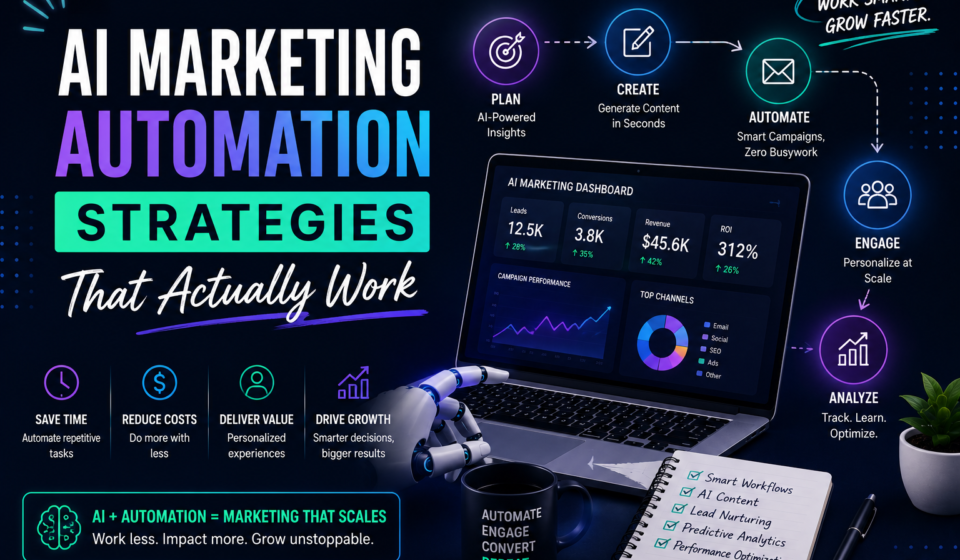

Artificial intelligence has transformed the way businesses approach marketing. Tasks that once required hours of manual effort, such as segmenting audiences, sending emails, analyzing campaign performance, and creating personalized content, can now be automated with remarkable accuracy. However, simply adding AI to your marketing stack doesn’t guarantee better results. Successful companies use AI strategically to improve efficiency, deliver personalized customer experiences, and make smarter decisions based on data.
Marketing automation powered by AI is no longer limited to large enterprises. Businesses of every size can use intelligent tools to streamline workflows, nurture leads, increase conversions, and build stronger customer relationships. The key is implementing strategies that solve real marketing challenges instead of automating everything without a clear purpose.
This guide explores AI marketing automation strategies that consistently deliver measurable results while helping businesses grow more efficiently.
What Is AI Marketing Automation?
AI marketing automation combines artificial intelligence with marketing software to automate repetitive tasks, analyze customer behavior, and optimize campaigns in real time.
Unlike traditional automation, AI continuously learns from customer interactions and uses data to improve future marketing decisions. It can predict customer behavior, personalize communication, recommend products, and optimize campaigns with minimal manual intervention.
Common applications include:
- Email marketing
- Customer segmentation
- Lead scoring
- Chatbots
- Social media management
- Content recommendations
- Advertising optimization
- Customer journey automation
- Predictive analytics
- Sales follow-ups
The objective is to create more relevant experiences while saving time and improving marketing performance.
Why AI Marketing Automation Matters
Modern consumers expect personalized experiences. Generic marketing messages are less effective because customers interact with brands across multiple platforms and expect businesses to understand their preferences.
AI helps marketers:
- Deliver personalized communication
- Improve campaign performance
- Respond to customers faster
- Increase productivity
- Reduce manual work
- Improve lead quality
- Make data-driven decisions
- Scale marketing efforts efficiently
Instead of replacing marketers, AI allows them to focus on creativity, strategy, and customer relationships.
Strategy 1: Automate Customer Segmentation
Not every customer has the same needs.
AI analyzes customer behavior, purchase history, demographics, browsing activity, and engagement patterns to create highly targeted audience segments.
Examples include:
- First-time visitors
- Returning customers
- High-value buyers
- Abandoned cart users
- Inactive subscribers
- Frequent purchasers
Targeted campaigns consistently outperform one-size-fits-all marketing.
Strategy 2: Personalize Email Marketing
Email remains one of the highest-performing digital marketing channels.
AI improves email campaigns by personalizing:
- Subject lines
- Product recommendations
- Send times
- Content blocks
- Follow-up sequences
- Calls to action
Rather than sending identical emails to every subscriber, AI tailors messages based on individual behavior and interests.
This often leads to higher open rates, click-through rates, and conversions.
Strategy 3: Use AI for Lead Scoring
Sales teams perform better when they focus on qualified prospects.
AI evaluates factors such as:
- Website visits
- Content downloads
- Email engagement
- Company size
- Purchase intent
- Previous interactions
Based on this information, leads receive scores that indicate how likely they are to convert.
Sales representatives can prioritize their outreach accordingly.
Strategy 4: Implement Intelligent Chatbots
AI-powered chatbots have evolved far beyond answering simple questions.
Modern chatbots can:
- Answer FAQs
- Recommend products
- Schedule appointments
- Capture leads
- Qualify prospects
- Provide order updates
- Route complex issues to human agents
Available around the clock, chatbots improve customer experience while reducing support workloads.
Strategy 5: Automate Social Media Management
Maintaining multiple social media platforms requires significant time.
AI assists by:
- Scheduling posts
- Recommending publishing times
- Generating caption ideas
- Monitoring engagement
- Identifying trending topics
- Analyzing campaign performance
Automation ensures consistent activity while allowing marketers to focus on meaningful engagement.
Strategy 6: Create Smarter Content Workflows
Content creation remains essential for digital marketing.
AI helps teams:
- Generate content outlines
- Suggest keywords
- Improve readability
- Identify content gaps
- Repurpose existing content
- Recommend internal links
Human editing remains essential to ensure originality, accuracy, and brand consistency.
Strategy 7: Automate Customer Journey Workflows
Every customer follows a different path before making a purchase.
AI automates workflows based on customer actions.
Examples include:
- Welcome email sequences
- Abandoned cart reminders
- Product recommendation emails
- Trial expiration reminders
- Customer onboarding
- Renewal notifications
These workflows deliver timely communication without manual effort.
Strategy 8: Improve Advertising Performance
AI continuously analyzes advertising campaigns and adjusts them based on performance.
It can optimize:
- Audience targeting
- Bid strategies
- Budget allocation
- Ad placement
- Creative performance
- Conversion tracking
This helps businesses maximize return on advertising spend.
Strategy 9: Predict Customer Behavior
Predictive analytics enables businesses to anticipate future customer actions.
AI can forecast:
- Purchase likelihood
- Customer churn
- Upselling opportunities
- Seasonal demand
- Product preferences
- Lifetime value
These insights help businesses make proactive marketing decisions.
Strategy 10: Automate Reporting and Analytics
Marketing generates enormous amounts of data.
AI simplifies reporting by automatically tracking:
- Website traffic
- Conversion rates
- Email performance
- Campaign ROI
- Customer acquisition
- Sales attribution
- Engagement metrics
Instead of manually creating reports, marketers receive actionable insights in real time.
Strategy 11: Optimize Customer Retention
Retaining existing customers is often more cost-effective than acquiring new ones.
AI identifies customers who may disengage by analyzing:
- Declining activity
- Reduced purchases
- Lower engagement
- Support interactions
Businesses can then launch personalized retention campaigns before customers leave.
Strategy 12: Align Sales and Marketing
AI improves collaboration between marketing and sales teams by sharing customer insights across both departments.
Benefits include:
- Better lead qualification
- Consistent customer messaging
- Faster follow-ups
- Improved forecasting
- Higher conversion rates
A connected customer journey creates a better overall experience.
Best Practices for AI Marketing Automation
To achieve the best results:
- Start with clear business goals.
- Automate repetitive tasks first.
- Keep customer data accurate.
- Review AI recommendations regularly.
- Combine automation with human creativity.
- Test campaigns continuously.
- Personalize customer experiences.
- Protect customer privacy and data.
AI works best when guided by a thoughtful marketing strategy.
Common Mistakes to Avoid
Businesses often struggle with AI automation because they:
- Automate poor processes
- Ignore customer feedback
- Depend entirely on AI-generated content
- Send too many automated messages
- Overlook data quality
- Fail to monitor campaign performance
- Neglect human interaction
Automation should enhance customer relationships, not replace them.
The Future of AI Marketing Automation
AI marketing continues to evolve rapidly.
Emerging trends include:
- Hyper-personalized customer experiences
- AI-powered voice marketing
- Predictive customer journeys
- Autonomous campaign optimization
- Advanced conversational AI
- Real-time personalization
- Smarter recommendation engines
- AI-assisted video marketing
Businesses that adopt these technologies responsibly will be better positioned to compete in increasingly digital markets.
Final Thoughts
AI marketing automation has become an essential part of modern business growth. When implemented strategically, it helps companies streamline repetitive tasks, improve customer engagement, personalize communication, and make better marketing decisions based on real-time data.
The most successful businesses use AI as a powerful assistant rather than a replacement for human creativity and strategic thinking. By combining intelligent automation with valuable content, genuine customer relationships, and continuous optimization, organizations can build marketing systems that generate sustainable growth and long-term customer loyalty.
Frequently Asked Questions (FAQs)
1. What is AI marketing automation?
AI marketing automation uses artificial intelligence to automate marketing tasks such as email campaigns, customer segmentation, lead scoring, social media management, analytics, and personalized communication.
2. How does AI improve marketing performance?
AI analyzes customer behavior, predicts future actions, personalizes campaigns, automates repetitive tasks, and provides insights that help marketers improve engagement, conversions, and return on investment.
3. Is AI marketing automation suitable for small businesses?
Yes. Many affordable AI-powered marketing platforms allow small businesses to automate emails, manage customer relationships, analyze campaigns, and improve productivity without large marketing teams.
4. Can AI replace human marketers?
No. AI is designed to assist marketers by handling repetitive work and analyzing data. Human creativity, strategic planning, storytelling, and relationship building remain essential for successful marketing.
5. What marketing tasks can be automated with AI?
Businesses commonly automate email marketing, lead scoring, customer segmentation, chatbot interactions, campaign reporting, social media scheduling, advertising optimization, and customer journey workflows.
6. How does AI personalize customer experiences?
AI uses customer data such as browsing behavior, purchase history, engagement patterns, and preferences to deliver relevant product recommendations, personalized emails, targeted advertisements, and customized website experiences.
7. What are the biggest benefits of AI marketing automation?
Key benefits include improved efficiency, higher conversion rates, better customer targeting, faster campaign optimization, enhanced personalization, reduced manual work, and more informed business decisions.
8. Are AI chatbots effective for customer support?
Yes. Modern AI chatbots can answer common questions, qualify leads, recommend products, schedule appointments, and escalate complex issues to human representatives when necessary.
9. What mistakes should businesses avoid when implementing AI marketing automation?
Common mistakes include automating ineffective processes, relying entirely on AI-generated content, neglecting customer feedback, sending excessive automated messages, and failing to monitor campaign performance.
10. How can businesses get started with AI marketing automation?
Begin by identifying repetitive marketing tasks, selecting reliable AI-powered tools, organizing customer data, setting measurable goals, testing automated workflows, and continuously reviewing results to improve performance over time.