
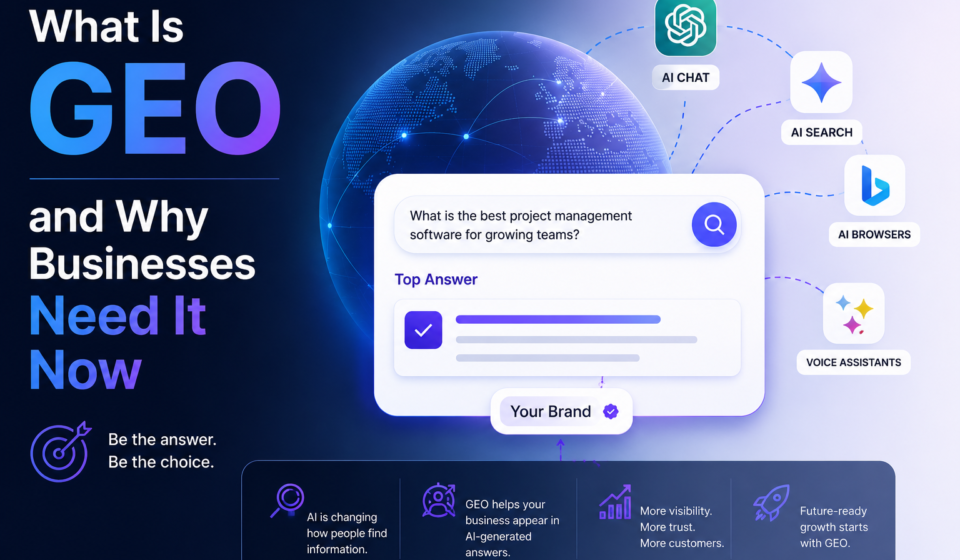

The digital marketing landscape is undergoing one of its biggest transformations since the introduction of search engines. For decades, businesses focused heavily on Search Engine Optimization (SEO) to increase visibility, drive traffic, and generate leads. However, the rapid rise of artificial intelligence platforms, generative search experiences, and AI-powered assistants has created a new discipline that businesses can no longer afford to ignore: Generative Engine Optimization, commonly known as GEO.
As consumers increasingly turn to AI tools to discover products, services, solutions, and information, traditional search behavior is evolving. Instead of typing short keyword queries into search engines and browsing through multiple websites, users are now asking conversational questions to AI platforms and expecting direct, comprehensive answers. This shift has fundamentally changed how businesses need to think about online visibility.
Generative Engine Optimization represents the process of optimizing content, brand presence, and digital authority so that artificial intelligence systems can accurately identify, understand, reference, and recommend businesses within AI-generated responses. As generative AI becomes integrated into search engines, virtual assistants, enterprise tools, and consumer applications, GEO is emerging as a critical component of modern digital marketing strategies.
Businesses that understand and implement GEO strategies today are positioning themselves to remain visible and competitive in an AI-driven future. Those that ignore this shift risk losing visibility, traffic, and customer opportunities as consumer behavior continues to evolve.
Understanding Generative Engine Optimization
Generative Engine Optimization refers to the practice of optimizing digital content and online presence to improve visibility within AI-generated responses. Unlike traditional SEO, which focuses on ranking web pages in search engine results pages, GEO focuses on ensuring that artificial intelligence systems recognize, trust, and reference a business when generating answers.
AI systems rely on large datasets, authoritative content, structured information, and contextual understanding to produce responses. Businesses that create trustworthy, well-organized, and comprehensive content are more likely to be referenced by these systems.
The primary objective of GEO is not necessarily to achieve higher rankings on traditional search engines but to become a trusted source that AI models use when generating responses to user queries.
As AI-powered search experiences continue to grow, businesses must adapt their content strategies to align with how generative systems retrieve, interpret, and present information.
Why GEO Has Become Important
The rapid adoption of artificial intelligence tools has significantly altered how consumers search for information. Millions of users now rely on AI assistants for recommendations, explanations, comparisons, and purchasing decisions.
Traditional search engines are also integrating AI-generated summaries and conversational experiences into their platforms. This shift reduces the number of clicks users make to individual websites because answers are increasingly provided directly within search interfaces.
As a result, businesses must optimize not only for search engine rankings but also for AI visibility. Companies that fail to establish authority within generative ecosystems may experience declining organic traffic and reduced brand awareness.
Generative Engine Optimization helps businesses maintain visibility in a digital environment where artificial intelligence increasingly serves as the primary intermediary between consumers and information.
GEO vs SEO: Understanding the Difference
Although GEO and SEO share similar objectives, they differ significantly in their approaches and optimization strategies.
| Factor | Traditional SEO | Generative Engine Optimization (GEO) |
|---|---|---|
| Primary goal | Rank web pages | Become a trusted AI source |
| User behavior | Keyword searches | Conversational queries |
| Content focus | Keywords and rankings | Context and authority |
| Success metric | Organic traffic | AI citations and mentions |
| Optimization approach | Search algorithms | AI understanding models |
| User journey | Search to website | AI response to decision |
| Content structure | Search optimized | Context optimized |
Traditional SEO remains important because search engines continue to drive substantial traffic. However, GEO introduces additional requirements that focus on authority, context, expertise, and semantic understanding.
Businesses that combine SEO and GEO strategies create stronger digital ecosystems capable of succeeding across both traditional and AI-powered search environments.
How AI Search Is Changing Consumer Behavior
Consumer search behavior has evolved dramatically over the past few years. Rather than conducting multiple searches and comparing numerous websites, users increasingly seek immediate, personalized answers from AI-powered systems.
Consumers now ask questions such as:
“What is the best accounting software for small businesses?”
“Which marketing platform offers the best return on investment?”
“What are the top cybersecurity solutions for startups?”
Instead of receiving a list of links, users receive comprehensive answers generated by artificial intelligence systems. These responses often include recommendations, comparisons, summaries, and contextual explanations.
This behavioral shift means businesses must optimize their digital presence to become part of these AI-generated conversations.
Organizations that successfully position themselves as authoritative sources increase their likelihood of appearing within AI-generated responses and influencing customer decisions.
The Core Principles of GEO
Generative Engine Optimization is built upon several foundational principles that help AI systems understand and trust business content.
Authority remains one of the most important factors. Artificial intelligence systems prioritize information from credible and trustworthy sources. Businesses that establish expertise within their industries improve their chances of being referenced.
Contextual relevance is equally important. AI systems evaluate not only specific keywords but also the broader meaning, relationships, and context surrounding information.
Content comprehensiveness also plays a significant role. Detailed, well-structured content provides AI systems with richer information that supports accurate response generation.
Consistency across digital platforms strengthens credibility. Businesses that maintain accurate information across websites, social platforms, directories, and publications create stronger signals of trustworthiness.
Finally, structured data and semantic organization help AI systems interpret information more effectively.
Creating Content for AI Discovery
Content creation strategies are evolving rapidly due to the rise of generative AI. Businesses can no longer rely exclusively on keyword density and traditional optimization techniques.
Instead, content must prioritize clarity, depth, authority, and user intent. AI systems favor content that provides comprehensive answers to real-world questions.
Businesses should create content that addresses customer concerns thoroughly while providing valuable context and actionable insights. Educational resources, research articles, industry analyses, case studies, and expert commentary perform particularly well in AI environments.
Conversational writing styles have also become increasingly important. Since users interact with AI systems using natural language, content optimized for conversational queries aligns more effectively with AI retrieval mechanisms.
Organizations that consistently produce valuable and authoritative content improve their visibility across generative search platforms.
The Role of E-E-A-T in GEO
Experience, Expertise, Authoritativeness, and Trustworthiness, commonly referred to as E-E-A-T, have become essential components of both SEO and GEO strategies.
Artificial intelligence systems prioritize information from sources that demonstrate genuine expertise and credibility. Businesses that establish strong reputations within their industries improve their chances of being cited by AI systems.
Expert-authored content, customer case studies, original research, professional credentials, and transparent business practices all contribute to stronger authority signals.
Trust has become particularly important in industries involving finance, healthcare, technology, education, and legal services, where misinformation can have significant consequences.
Organizations that invest in building authentic expertise create long-term advantages in both traditional and AI-powered search environments.
Structured Data and Semantic Understanding
Structured data helps search engines and AI systems understand website content more accurately. By implementing structured markup, businesses provide machines with clear information about products, services, organizations, reviews, articles, and events.
Semantic search technologies focus on understanding relationships between concepts rather than simply matching keywords. As a result, businesses must optimize content around topics, entities, and user intent rather than isolated search terms.
Proper semantic organization improves the ability of AI systems to interpret content accurately and reference businesses appropriately within generated responses.
Structured content also enhances discoverability across emerging AI ecosystems and knowledge graphs.
Brand Authority in the Age of AI
Brand authority has become one of the most valuable assets in digital marketing. AI systems frequently rely on established brands and recognized experts when generating responses.
Businesses can strengthen their authority by publishing original research, participating in industry discussions, earning media coverage, and developing thought leadership content.
Strong brands benefit from increased recognition, improved trust signals, and greater visibility across digital channels. These advantages translate directly into stronger performance within generative search environments.
Companies that consistently demonstrate expertise and reliability position themselves as preferred information sources for both human audiences and AI systems.
GEO and Content Marketing Strategy
Content marketing remains central to successful GEO implementation. However, content strategies must evolve to accommodate the requirements of artificial intelligence systems.
Businesses should focus on creating comprehensive content ecosystems that address customer journeys from multiple perspectives. Educational content, comparison guides, industry reports, FAQs, tutorials, and expert insights contribute to stronger authority.
Long-form content often performs particularly well because it provides richer contextual information. AI systems benefit from detailed explanations that establish relationships between concepts and topics.
Content freshness also remains important. Regular updates signal ongoing relevance and improve the likelihood of being referenced by AI platforms.
Organizations that invest consistently in high-quality content development create sustainable competitive advantages.
Measuring GEO Success
Unlike traditional SEO, where rankings and traffic provide clear performance indicators, measuring GEO effectiveness requires additional metrics.
Businesses increasingly monitor brand mentions, AI citations, referral patterns, authority indicators, and visibility across AI platforms.
Customer acquisition channels may also shift as AI-generated recommendations influence purchasing decisions. Organizations should track changes in branded search volume, direct traffic, and customer attribution models.
Monitoring industry conversations and AI-generated responses helps businesses understand how their brands are represented within generative ecosystems.
As GEO evolves, measurement frameworks will continue becoming more sophisticated.
Industries Most Affected by GEO
Certain industries are experiencing particularly significant impacts from the rise of generative search.
Software companies increasingly compete for AI-generated recommendations during product evaluations and purchasing decisions.
Healthcare organizations must ensure accurate representation within medical information systems and patient guidance platforms.
Financial institutions rely on trust and authority signals that strongly influence AI-generated recommendations.
Educational organizations benefit from creating authoritative educational content that AI systems can reference.
Professional service providers, including consultants, legal firms, and agencies, also face increasing pressure to establish strong digital authority.
Virtually every industry will eventually experience the effects of AI-driven information discovery.
Challenges Businesses Face With GEO
Implementing GEO strategies presents several challenges. Many businesses struggle to understand how AI systems retrieve and prioritize information.
The rapidly evolving nature of artificial intelligence technologies creates uncertainty regarding best practices and measurement standards.
Creating authoritative content requires substantial investments in research, expertise, and ongoing content development.
Competition for AI visibility is increasing as more organizations recognize the importance of generative optimization.
Additionally, businesses must balance traditional SEO requirements with emerging GEO strategies without compromising overall marketing effectiveness.
Despite these challenges, early adopters may gain significant competitive advantages.
How Businesses Can Start Implementing GEO Today
Businesses interested in improving their generative search visibility should begin by evaluating their existing digital presence and authority.
Developing comprehensive, high-quality content should become a primary priority. Organizations should focus on answering customer questions thoroughly while demonstrating expertise.
Strengthening brand authority through thought leadership, media exposure, and original research contributes to improved AI visibility.
Implementing structured data and improving semantic organization enhances machine understanding.
Businesses should also monitor AI-generated responses related to their industries to understand emerging patterns and opportunities.
Most importantly, organizations should view GEO as a long-term strategic investment rather than a short-term optimization tactic.
The Future of Generative Engine Optimization
Generative Engine Optimization will likely become one of the most important disciplines in digital marketing over the next decade. As artificial intelligence becomes increasingly integrated into search, commerce, customer service, and decision-making processes, businesses must adapt accordingly.
Future AI systems will become more sophisticated in evaluating expertise, trustworthiness, and contextual relevance. Organizations that establish strong authority today will benefit from increased visibility as these technologies evolve.
Traditional SEO will remain valuable, but GEO will become an essential complementary strategy for maintaining digital competitiveness.
Businesses that embrace this transformation early will be better positioned to thrive in an increasingly AI-driven economy.
Conclusion
Generative Engine Optimization represents the next major evolution in digital visibility. As consumers increasingly rely on artificial intelligence systems for information, recommendations, and purchasing decisions, businesses must adapt their marketing strategies to remain competitive.
GEO focuses on ensuring that AI systems recognize, trust, and reference businesses when generating responses. Through authoritative content creation, semantic optimization, structured data implementation, and brand building, organizations can strengthen their visibility within emerging AI ecosystems.
The shift toward AI-driven search behavior is already underway. Businesses that invest in GEO today are preparing themselves for a future in which artificial intelligence plays a central role in how customers discover, evaluate, and engage with brands.
Rather than replacing traditional SEO, Generative Engine Optimization expands the digital marketing landscape and creates new opportunities for businesses willing to innovate and adapt.
Frequently Asked Questions
What does GEO stand for in digital marketing?
GEO stands for Generative Engine Optimization, which refers to optimizing content and digital presence for visibility within AI-generated search responses and recommendations.
Is GEO replacing traditional SEO?
No. GEO is not replacing SEO. Instead, it complements traditional search optimization by helping businesses remain visible within AI-powered search experiences.
Why is GEO important for businesses?
GEO is important because consumers increasingly use artificial intelligence tools to discover information, products, and services. Businesses must optimize for these platforms to maintain visibility.
How does AI choose which businesses to recommend?
AI systems typically prioritize authoritative, trustworthy, relevant, and well-structured information from credible sources across the internet.
What types of businesses benefit most from GEO?
Virtually all businesses can benefit from GEO, particularly companies in technology, healthcare, finance, education, software, and professional services.
How can businesses start improving their GEO strategy?
Businesses should focus on creating authoritative content, improving brand credibility, implementing structured data, strengthening digital presence, and monitoring AI-generated responses related to their industry.