
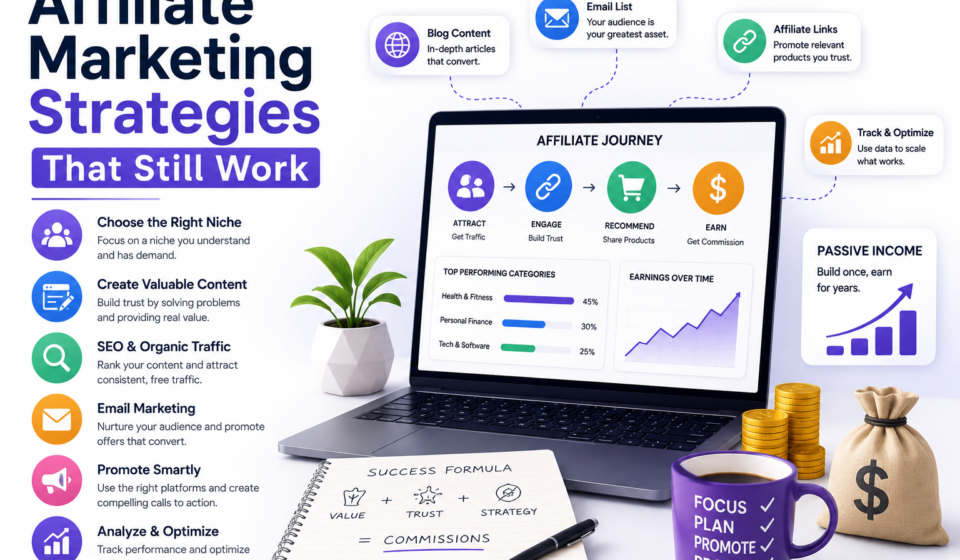

Affiliate marketing continues to be a practical way for creators, publishers, bloggers, influencers, and niche websites to generate revenue online. While the industry has changed significantly, the basic principle remains simple. An affiliate promotes a product or service and earns a commission when a referred customer completes a qualifying action.
The biggest change is that audiences have become more selective. People are less likely to trust pages filled with generic recommendations or obvious promotional content. Successful affiliate marketing now depends on credibility, useful information, strong audience understanding, and genuine product evaluation.
The strategies that continue to work are those that help people make better purchasing decisions.
Choose a Specific Niche
A focused niche gives affiliate marketers a stronger foundation.
Instead of creating content about unrelated products, choose a subject where the audience has consistent buying needs. Examples include business software, personal finance, fitness equipment, travel products, online education, technology, home improvement, or professional services.
A focused niche allows you to develop deeper knowledge and create content that addresses specific customer problems.
It also makes it easier to build an identifiable audience. Someone looking for detailed information about accounting software is more likely to trust a specialized business resource than a general website that occasionally publishes software recommendations.
Promote Products You Understand
Affiliate marketing becomes much more effective when the publisher understands the products being recommended.
Before promoting a product, learn how it works, who it is designed for, its limitations, pricing structure, major features, and alternatives.
If possible, use the product yourself.
Firsthand experience allows you to provide practical observations that generic promotional pages cannot easily replicate.
You can explain what worked well, what could be improved, which users may benefit most, and which users may need another solution.
Honest recommendations build stronger relationships with audiences.
Create Comparison Content
Comparison articles remain valuable because customers often research multiple options before purchasing.
Content such as product A versus product B, best alternatives to a specific platform, or top tools for a particular business need can help readers evaluate their choices.
Good comparison content should go beyond listing features.
Explain differences in pricing, usability, target audience, capabilities, customer support, limitations, and practical use cases.
The objective is to help readers understand which option is most appropriate for their situation.
A balanced comparison can build more trust than an article that presents one product as perfect.
Write Product Reviews With Real Insight
Product reviews can attract highly interested visitors because people often search for opinions before making a purchase.
However, a useful review needs more than a summary of information already available on the product website.
A strong review can include:
• Who the product is best suited for
• Main strengths
• Important limitations
• Ease of use
• Pricing considerations
• Real world use cases
• Alternatives
• Frequently encountered problems
• Overall suitability
The review should answer the question behind the search: Is this product actually right for me?
Target High Intent Searches
Not every website visitor has the same level of buying interest.
Someone searching for “what is project management software” may still be learning about the category. Someone searching for “best project management software for small agencies” is likely much closer to making a decision.
Affiliate marketers can create content for different stages of the customer journey, but high intent topics can be particularly valuable.
Examples include:
“Best accounting software for freelancers”
“Best alternatives to a specific platform”
“Project management tools for remote teams”
“Best email marketing platforms for small businesses”
These topics often connect directly with purchasing decisions.
Build Helpful Buying Guides
Buying guides allow affiliate marketers to combine education and product recommendations.
A guide can explain what customers should consider before purchasing, which features matter, what mistakes to avoid, and which types of products suit different needs.
For example, a guide about business laptops could explain performance requirements, portability, battery life, security features, warranty considerations, and pricing categories.
Products can then be introduced according to different use cases.
This makes the affiliate content useful even before the reader reaches the recommendation section.
Use Tutorials to Introduce Products Naturally
Tutorial content can attract people who are trying to accomplish a specific task.
A tutorial might explain how to create a website, manage customer invoices, edit videos, organize business projects, or automate repetitive work.
If an affiliate product helps complete that task, it can be introduced naturally within the tutorial.
This approach is powerful because the recommendation is connected to a real problem.
Instead of saying, “Buy this software,” the content explains how the reader can complete a task and shows where a particular tool can make the process easier.
Develop Long Form Resource Content
Detailed resources can become important traffic and authority assets.
A comprehensive guide can cover a subject from multiple angles and include examples, checklists, comparisons, tools, and practical recommendations.
Long form content should not be created simply to increase word count.
The goal is completeness.
If readers can find the answers they need in one resource, the page becomes more useful and more likely to earn repeat visits, references, and shares.
Build Email Lists
Affiliate marketers who depend entirely on search or social platforms have limited control over their audience.
An email list provides a direct communication channel.
A newsletter can include useful recommendations, new reviews, product updates, tutorials, industry insights, and special offers.
The strongest affiliate newsletters provide value consistently rather than sending promotional links every day.
Trust develops when subscribers know that the recommendations are selected because they are useful, not simply because they generate commissions.
Use Video Content
Video gives affiliate marketers another way to demonstrate products.
A software tutorial, product walkthrough, equipment demonstration, or comparison video can help potential buyers understand how something works.
Video can also communicate details that are difficult to explain through text.
For physical products, showing the product in use can make recommendations more credible. For software, screen recordings can demonstrate workflows and features.
Videos can be distributed through multiple platforms and embedded within relevant website content.
Build Topic Authority
Successful affiliate websites often become known for a particular subject.
Instead of publishing hundreds of unrelated product pages, build a collection of interconnected resources around a specific area.
For example, a business software affiliate website could cover accounting platforms, CRM systems, project management tools, communication software, invoicing platforms, and automation solutions.
Supporting content can explain how these tools work and how businesses can select between them.
This creates a stronger information ecosystem and gives visitors more reasons to explore the website.
Use Social Media for Discovery
Social media can help affiliate content reach new audiences, especially when the content is adapted to each platform.
Short videos can demonstrate products. Visual posts can summarize comparisons. Threads can explain purchasing decisions. Professional posts can share business software recommendations.
Social media should not simply duplicate website headlines.
Adapt the information to the platform and audience.
A useful social post can attract attention and direct interested users toward a detailed review or buying guide.
Build Trust Through Transparency
Affiliate disclosure is important for maintaining audience trust.
Readers should understand when a publisher may earn a commission from a recommendation.
Transparency does not necessarily reduce conversions. In many cases, it can increase credibility because readers know the publisher is being open about the commercial relationship.
Affiliate content should also avoid making unsupported claims.
If a product has limitations, explain them.
A recommendation becomes more believable when it acknowledges both benefits and drawbacks.
Update Older Affiliate Content
Affiliate content can lose value when prices, features, products, and market conditions change.
Older articles should be reviewed periodically.
Update pricing information, product availability, screenshots, features, alternatives, links, and recommendations when necessary.
A comparison article written several years ago may no longer reflect the current market.
Keeping important content accurate protects both credibility and potential revenue.
Diversify Affiliate Revenue
Depending on one affiliate program can create unnecessary risk.
Programs can change commission rates, modify terms, discontinue products, or close entirely.
Affiliate marketers can reduce this risk by working with several relevant programs and developing multiple content categories.
However, diversification should remain logical.
Promoting too many unrelated products can weaken audience trust.
The products should still fit the site’s niche and customer needs.
Focus on Recurring Commissions
Some affiliate programs provide one time commissions, while others offer recurring commissions for subscription based products.
Recurring commissions can create a more predictable revenue stream when customers remain subscribed.
This makes SaaS products, memberships, hosting services, professional platforms, and subscription businesses particularly interesting for certain affiliate publishers.
However, commission structure should not be the only consideration.
A product with a lower commission but strong customer retention may be more valuable than a product offering a large initial payout.
Use Data to Improve Performance
Affiliate marketing should be measured like any other business activity.
Important metrics can include clicks, conversion rates, earnings per click, revenue per visitor, top performing pages, traffic sources, and customer actions.
A page receiving significant traffic but producing few affiliate clicks may need better placement or stronger recommendations.
A page with strong clicks but poor conversions may indicate that the audience is not well matched to the product.
Data helps marketers understand what needs improvement.
Create Content Around Problems, Not Just Products
One of the strongest long term strategies is to focus on problems rather than brands.
People search for solutions because they have a need.
They may want to reduce business expenses, improve productivity, create a website, protect their data, manage finances, learn a skill, or choose better equipment.
Affiliate marketers can create content around these problems and introduce relevant products as potential solutions.
This makes the content more useful and reduces dependence on individual product pages.
Avoid Aggressive Promotion
Affiliate marketing works best when the recommendation feels natural.
Too many banners, popups, buttons, and promotional messages can make a website difficult to use.
The best affiliate content places recommendations where they are relevant.
If a reader is comparing products, provide a comparison table. If they are following a tutorial, introduce the relevant tool at the appropriate step. If they are reading a review, explain the product’s strengths and limitations clearly.
The recommendation should support the reader’s decision rather than interrupt it.
Combine Affiliate Marketing With Other Revenue Streams
Affiliate marketing does not have to be the only source of income.
A content business can combine affiliate commissions with advertising, digital products, subscriptions, consulting, sponsorships, courses, or other services.
Multiple revenue streams can make the business more resilient.
However, each additional revenue source should fit naturally into the audience and content strategy.
Conclusion
Affiliate marketing still works, but the strategies that succeed today are built around usefulness and trust rather than simply inserting affiliate links into large volumes of content.
Focused niches, detailed reviews, comparison guides, tutorials, buying resources, video demonstrations, email marketing, social distribution, and transparent recommendations can all contribute to sustainable affiliate revenue.
The strongest affiliate marketers understand that their real product is not the affiliate link. It is the information and guidance they provide before someone clicks it.
When content helps people understand their choices and make better purchasing decisions, affiliate marketing becomes more than a commission model. It becomes a long term content business built around expertise, trust, and genuine customer value.