
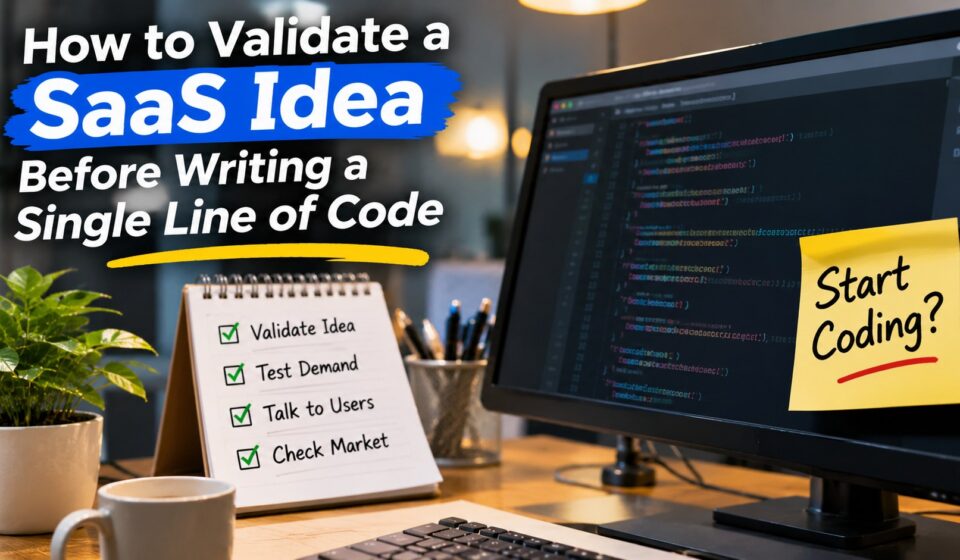

A founder gets an idea for a software product. It sounds useful, the market appears large and a few friends say they would definitely use it. Excited by the possibility, the founder spends several months building features, choosing a technology stack and preparing a launch.
Then the product goes live.
Visitors arrive, a few people create accounts, but almost nobody pays. Some users say the idea is interesting, others request features, and the founder is left wondering why a product that seemed so promising has failed to attract customers.
This situation is more common than many aspiring SaaS founders expect.
The problem is not necessarily poor engineering or a weak product. It may be that the founder built something before confirming whether a real group of customers wanted it badly enough to pay.
Validating a SaaS idea before development can save months of work and a significant amount of money. It allows founders to test demand, understand customer behaviour, identify pricing expectations and discover which features actually matter.
You do not need a working application to begin. You need a problem, access to potential customers and a structured way to test your assumptions.
The First Question Is Not “Would You Use This?”
When someone asks a potential customer whether they like a product idea, the answer is often unreliable.
People are naturally encouraging. They may say an application sounds useful because they want to be supportive, not because they intend to purchase it.
A stronger validation question focuses on an existing problem.
Imagine you want to build a SaaS platform that automatically organises customer enquiries for small marketing agencies.
Instead of asking:
“Would you use a tool that organises customer enquiries?”
Ask:
- How do you currently manage incoming enquiries?
- What happens when several enquiries arrive at the same time?
- Have you ever lost a potential customer because a message was missed?
- Which tools are you currently paying for?
- How much time does your team spend organising enquiries?
- Have you tried to solve this problem before?
These questions reveal actual behaviour rather than hypothetical interest.
If customers already spend time or money addressing the problem, you have a stronger starting point.
Step 1: Identify a Problem Worth Paying to Solve
Not every inconvenience deserves a software product.
People may complain about minor frustrations without being willing to pay for a solution. A promising SaaS opportunity usually addresses a problem that is frequent, expensive, time consuming or important to business operations.
Evaluate your idea using four dimensions.
| Validation factor | What you should investigate |
|---|---|
| Frequency | How often does the problem occur? |
| Impact | Does it cost time, money or opportunities? |
| Existing solutions | What are customers using today? |
| Urgency | Do customers actively want a better solution? |
Consider two possible ideas.
The first is an application that changes the background colour of a task list. Some users may find it attractive, but the problem is unlikely to be urgent.
The second is a tool that helps independent accountants collect missing documents from clients before filing deadlines. Delays can create administrative pressure and affect business operations.
The second idea may have a clearer commercial purpose because it addresses a recurring workflow.
Before moving forward, write a one sentence problem statement:
“My target customer struggles with [specific problem], which causes [measurable consequence].”
If you cannot complete this sentence clearly, you may need more customer research.
Step 2: Define a Narrow Customer Group
One of the biggest mistakes new SaaS founders make is targeting everyone.
A product described as a productivity platform for businesses is difficult to validate because it does not identify a specific buyer.
A narrower audience makes your research more useful.
For example:
| Broad target | More specific target |
|---|---|
| Small businesses | Independent dental clinics |
| Marketing professionals | Freelance social media managers |
| Online retailers | Shopify stores with large product catalogues |
| Consultants | Independent financial consultants |
| Recruitment companies | Small recruitment agencies hiring for technology roles |
A narrow market does not necessarily mean a small opportunity. It gives you a clearer group of people to interview, understand and reach.
You can expand later if the initial customer segment demonstrates strong demand.
Create a simple customer profile that answers:
- Who experiences the problem?
- Who makes the purchasing decision?
- How do they currently solve it?
- What budget might they have?
- Where can you reach them?
This profile will guide every subsequent validation activity.
Step 3: Investigate What Customers Already Use
A competitor is not automatically a reason to abandon your idea.
In fact, existing competitors can provide useful evidence that people recognise the problem and are willing to pay for solutions.
Your task is to understand where current options fall short.
Study five to ten products that address the same or a related problem. Look at their pricing, features, target customers, onboarding process and customer feedback.
Pay particular attention to complaints that appear repeatedly.
For example, customers might say:
- The product is too complicated for a small team.
- Important features are only available in expensive plans.
- Setup takes too long.
- Reports are difficult to understand.
- Customer support is slow.
- The product does not integrate with a tool they already use.
These observations may reveal a gap worth investigating.
However, do not assume every negative review represents a profitable opportunity. A complaint matters only if enough customers experience it and are willing to pay for a better alternative.
Step 4: Conduct 15 to 25 Customer Conversations
Direct conversations are among the most useful early validation methods.
You do not need hundreds of interviews to discover whether your assumptions are wrong. A focused group of 15 to 25 relevant people can reveal recurring patterns, although it cannot prove market demand on its own.
Look for people who genuinely fit your target customer profile.
You can find them through professional communities, industry groups, founder networks, existing business contacts and personalised outreach.
Keep each conversation focused on the customer’s current workflow.
A useful interview structure might look like this:
Opening: Ask the person to describe how they currently handle the problem.
Current process: Understand the tools, people and steps involved.
Pain points: Find out what creates delays, errors or additional costs.
Previous attempts: Ask whether they have tried another solution.
Financial impact: Explore how the problem affects their time, revenue or operating expenses.
Buying behaviour: Ask who would approve a purchase and what would influence the decision.
Avoid presenting your product too early. If you explain your idea before understanding the customer’s situation, their answers may become influenced by your enthusiasm.
The goal is to discover whether the problem exists independently of your proposed solution.
Step 5: Create a Landing Page Before Building the Product
A landing page can help you test whether your proposed solution attracts attention from the right audience.
You do not need a complicated website. A single page is enough to communicate the offer.
Include five essential elements:
A clear headline: Explain the result your product promises to deliver.
The customer problem: Describe the situation your audience recognises.
The proposed solution: Explain how the software would make the process easier.
A simple demonstration: Use a mockup or illustration to show the intended workflow.
A measurable action: Ask visitors to join a waitlist, request early access or book a discovery call.
Avoid vague headlines such as “The future of business productivity.”
A more specific headline might be:
“Collect missing client documents without chasing every customer manually.”
The second headline tells a particular audience what the product is intended to improve.
Measure relevant actions rather than celebrating page visits alone.
Useful signals include qualified waitlist registrations, demo requests and enquiries from people who match your intended customer profile.
A large number of visitors with no meaningful interest is not strong validation.
Step 6: Demonstrate the Product Without Developing It
You can show customers how your SaaS product would work before writing the software.
This is where mockups, clickable prototypes and simple demonstrations become valuable.
A prototype does not need to function like the final product. It needs to help a potential customer understand the proposed experience.
For example, if you are planning an invoice follow up platform, demonstrate:
- A dashboard showing unpaid invoices.
- A customer record with payment information.
- A reminder scheduling screen.
- An example of a follow up message.
- A report showing overdue payments.
You can create these screens using design software or presentation tools.
During demonstrations, observe how customers react. Do they immediately understand the purpose? Do they ask how to use it? Do they request a feature that would solve a real problem?
More importantly, ask whether they would consider paying for the solution and what would need to be true before they could purchase it.
A positive reaction is useful feedback. A commitment to a paid pilot is a much stronger commercial signal.
Step 7: Test Whether People Will Actually Pay
Interest and purchasing intent are not the same thing.
Someone may join a free waitlist because the product looks interesting. That does not establish that the business can generate revenue.
To test willingness to pay, introduce a clear commercial offer.
You might offer:
- A paid early access programme.
- A limited pilot for a small group of businesses.
- A setup and onboarding package.
- A discounted first year subscription.
- A refundable reservation payment with clear terms.
Be transparent about the product’s development status. Never suggest that a fully operational application exists if it does not.
For example, a founder planning a SaaS tool for independent recruiters could approach ten agencies with a paid pilot offer.
The offer might include a defined trial period, limited functionality, onboarding assistance and a clear price.
If several qualified customers agree to pay for the pilot, the founder has stronger evidence than a hundred informal compliments.
Do not collect payments without clearly explaining delivery timelines, refund terms and the risks of purchasing an unfinished product.
Step 8: Find the Smallest Feature Set Customers Need
Founders often begin development with a long feature list.
This can lead to months of unnecessary engineering. Customers may not need advanced reporting, custom dashboards, complex integrations and multiple user roles from the beginning.
Instead, identify the smallest version of the product that solves the core problem.
Suppose your idea is a SaaS platform for managing freelance client projects.
Potential features might include:
| Feature | Initial priority |
|---|---|
| Create a client project | Essential |
| Track task status | Essential |
| Share project updates | Important |
| Generate advanced analytics | Later |
| Custom dashboard themes | Later |
| Complex team permissions | Later |
| Multiple third party integrations | Later |
Ask potential customers which action they need to complete first.
A useful MVP should make one important task easier. It does not need to look like a mature enterprise platform.
The best starting product is often much smaller than the founder initially imagines.
Step 9: Run a Manual Version of the Service
One of the most overlooked validation methods is delivering the result manually before automating it.
This is sometimes called a concierge MVP.
Imagine you want to build a SaaS product that analyses customer feedback and produces weekly reports.
Before developing a dashboard, you could collect feedback from a few pilot customers, analyse it using existing tools and send them a structured report.
This approach helps you understand:
- Which information customers actually value.
- How frequently they need reports.
- What level of detail they expect.
- Which parts of the workflow can be automated.
- Whether the result is worth paying for.
Manual delivery is not the final business model. It is a way to learn what the eventual software must do.
If customers do not value the manually delivered result, automating it may not solve the underlying demand problem.
Step 10: Decide Whether to Build, Change or Stop
Validation should lead to a decision, not an endless research process.
At this stage, review the evidence you have collected.
Use a simple scorecard:
| Evidence | Weak signal | Stronger signal |
|---|---|---|
| Customer interviews | General interest | Repeated problem descriptions |
| Existing solutions | No clear customer behaviour | Customers already pay for alternatives |
| Landing page | Unqualified visits | Relevant demo requests |
| Prototype | Compliments | Specific requests to use it |
| Pricing | Avoidance of price discussion | Acceptance of a paid pilot |
| Manual delivery | Low engagement | Repeat use and willingness to continue |
There is no universal score that proves a SaaS idea will succeed. The quality and consistency of evidence matter more than the number of positive responses.
You have three possible decisions.
Build: Proceed when you have identified a clear customer group, recurring problem and credible evidence of willingness to pay.
Change direction: Adjust the audience, pricing or core solution if customers value the problem but reject your original approach.
Stop: Abandon the idea if the problem is weak, customers are unwilling to pay or the solution cannot create enough value to justify its cost.
Stopping early is not failure. It is often a more responsible use of a founder’s time and resources.
A 14 Day SaaS Validation Plan
If you want to turn the process into an actual schedule, use this two week framework.
| Day | Activity | Expected outcome |
|---|---|---|
| 1 | Write the problem statement | Clear problem definition |
| 2 | Choose a target customer group | Specific audience |
| 3 | Research existing alternatives | Competitor overview |
| 4 to 6 | Conduct customer interviews | Real customer insights |
| 7 | Review interview patterns | Refined problem statement |
| 8 | Create a landing page | Public offer |
| 9 | Build a clickable prototype | Demonstration |
| 10 to 11 | Show it to potential customers | Usability feedback |
| 12 | Present a paid pilot offer | Pricing feedback |
| 13 | Review commitments and objections | Commercial evidence |
| 14 | Decide whether to build or adjust | Development decision |
This schedule is a starting framework. Some industries require longer research cycles, particularly when purchasing decisions involve legal, security or procurement reviews.
Final Thoughts
A SaaS idea becomes a business opportunity only when it connects a real customer problem with a solution people are willing to pay for.
Building software is an important part of the journey, but it should not be the first proof that your idea deserves investment.
Talk to potential customers. Study their current workflows. Show them a prototype. Test a commercial offer. Deliver a small version manually if necessary.
These steps can reveal problems that would otherwise remain hidden until after launch.
The objective is not to prove that your original idea is brilliant. It is to discover whether a valuable business exists behind it.
Before hiring developers, choosing a database or planning a complex product roadmap, make sure someone actually wants what you are preparing to build.
Frequently Asked Questions
1. How do I validate a SaaS idea without coding?
Start with customer interviews, competitor research, a landing page, a clickable prototype and a paid pilot offer. You can also deliver the proposed service manually to understand what customers value before automating it.
2. How many people should I interview before building a SaaS product?
Interviewing 15 to 25 relevant potential customers can provide useful early insights. However, the right number depends on the market, customer diversity and complexity of the problem. Look for repeated patterns rather than treating a particular interview count as proof of demand.
3. Is a landing page enough to validate a SaaS idea?
No. A landing page can measure interest and attract potential customers, but visits and email registrations do not establish willingness to pay. Combine it with customer conversations, product demonstrations and commercial tests.
4. What is a concierge MVP?
A concierge MVP is a basic version of a product where the founder manually delivers the result that software would eventually automate. It helps test whether customers value the outcome before investing in development.
5. Should I build an MVP or conduct market research first?
Conduct initial market research before building an MVP. Understanding the customer, problem and existing alternatives helps you decide which features belong in the first version.
6. How can I know if customers will pay for my SaaS?
Present a clear offer with a price and ask qualified customers to commit to a paid pilot or early access arrangement. Actual purchasing commitments are stronger evidence than general expressions of interest.
7. What if competitors already offer the same SaaS product?
Competition does not automatically invalidate your idea. Investigate whether customers are dissatisfied with existing options and whether you can serve a particular segment more effectively. Avoid entering a market without a meaningful reason customers would switch.
8. What is the biggest mistake when validating a SaaS idea?
Asking leading questions and confusing compliments with demand. Founders should investigate what customers currently do, what the problem costs them and whether they are willing to pay for a better solution.
9. How much does SaaS idea validation cost?
It can be conducted with a small budget using free research, communication, design and website tools. Costs increase if you commission professional research, purchase software subscriptions or run paid customer acquisition experiments.
10. When should I stop validating and start building?
Consider development when you have a clearly defined customer group, evidence of a recurring problem, an understandable solution and credible signs of willingness to pay. You do not need perfect certainty, but you should have enough evidence to justify the next investment.